Overview
Catalog No.
RHE12103
Species reactivity
Human, Mouse, Rat
Host species
Mouse
Isotype
IgG2b
Clonality
Monoclonal
Applications
ELISA, FCM, IHC, WB
Recommended Dilution
| Application |
Dilution |
| ELISA |
1:10000, FCM: 1:200-1:400, IHC: 1:200-1:1000, WB: 1:500-1:2000 |
Target
Cytokeratin-9, K9, Keratin-9, CK-9, KRT9, Keratin, type I cytoskeletal 9
Concentration
1 mg/ml
Endotoxin level
Please contact with the lab for this information.
Purity
>95% as determined by SDS-PAGE.
Purification
Protein A/G purified from cell culture supernatant.
Accession
P35527
Form
Liquid
Storage buffer
0.01M PBS, pH 7.4, 0.05% Sodium Azide.
Stability and Storage
Use a manual defrost freezer and avoid repeated freeze-thaw cycles. Store at 4°C short term (1-2 weeks). Store at -20°C 12 months. Store at -80°C long term.
Clone ID
R3J77
Note
For research use only.
Data Image
-
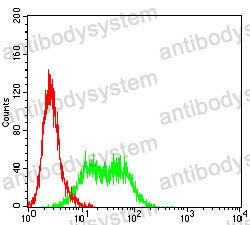
Flow cytometric analysis of A431 cells using KRT9 mouse mAb (green) and negative control (red).
-
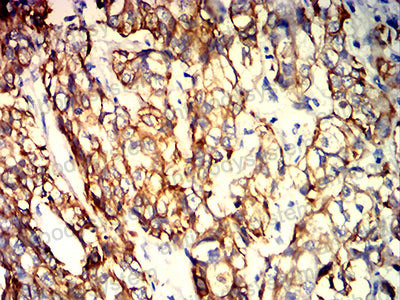
Immunohistochemical analysis of paraffin-embedded human bladder cancer tissues using KRT9 mouse mAb with DAB staining.
-
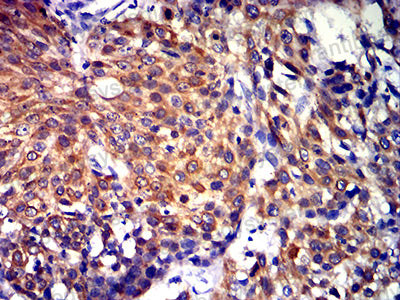
Immunohistochemical analysis of paraffin-embedded human esophageal cancer tissues using KRT9 mouse mAb with DAB staining.
-
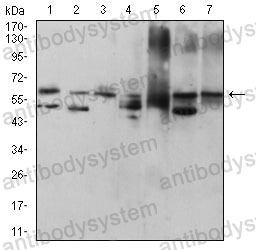
Western blot analysis using KRT9 mouse mAb against HepG2 (1), MCF-7 (2), NIH/3T3 (3), rat heart (4), mouse heart (5), Hela (6), and HUVEC (7) cell lysate.
References
Homozygous nonsense mutation in helix 2 of K14 causes severe recessive epidermolysis bullosa simplex., PMID:9554744
To Control Site-Specific Skin Gene Expression, Autocrine Mimics Paracrine Canonical Wnt Signaling and Is Activated Ectopically in Skin Disease., PMID:27105735
Drug-induced keratin 9 interaction with Hsp70 in bladder cancer cells., PMID:29802537
Functional study of 14-3-3 protein epsilon (YWHAE) in keratinocytes: microarray integrating bioinformatics approaches., PMID:31244373
Proteomic profiling reveals KRT6C as a probable hereterodimer partner for KRT9: New insights into re-classifying epidermolytic palmoplantar keratoderma (EPPK) and a milder form of pachyonychia congenita (PC-K6c) as a group of genetic cutaneous disorders., PMID:37467889
Datasheet

 For research use only. Not for human or drug use.


