Catalog No.
RHK44401
Species reactivity
Human, Mouse, Rat
Host species
Rabbit
Isotype
IgG
Clonality
Monoclonal
Applications
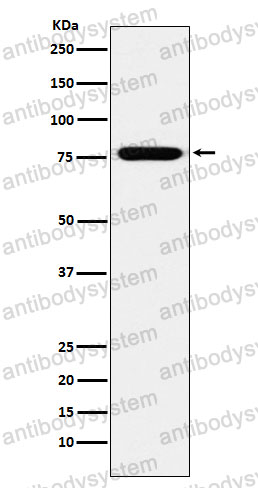
IP, WB
Recommended Dilution
| Application |
Dilution |
| IP |
1:20-1:50, WB: 1:1000-1:2000 |
Target
Microtubule plus end-directed kinesin motor 3A, Kinesin-like protein KIF3A, KIF3A, KIF3
Concentration
1 mg/ml
Endotoxin level
Please contact with the lab for this information.
Purity
>95% by SDS-PAGE.
Purification
Protein A/G purified from cell culture supernatant.
Accession
Q9Y496
Form
Liquid
Storage buffer
0.01M PBS, pH 7.4, 0.05% BSA, 50% Glycerol, 0.05% Sodium azide.
Stability and Storage
Use a manual defrost freezer and avoid repeated freeze thaw cycles. Store at 4 ℃ for frequent use. Store at -20 ℃ for twelve months from the date of receipt.
Clone ID
R2M12
Note
For research use only.
KIF3A is a new microtubule-based anterograde motor in the nerve axon., PMID:7515068
KIF2 is a new microtubule-based anterograde motor that transports membranous organelles distinct from those carried by kinesin heavy chain or KIF3A/B., PMID:7535303
KIF3A/B: a heterodimeric kinesin superfamily protein that works as a microtubule plus end-directed motor for membrane organelle transport., PMID:7559760
Localization of kinesin superfamily proteins to the connecting cilium of fish photoreceptors., PMID:8718680
Cloning and characterization of KAP3: a novel kinesin superfamily-associated protein of KIF3A/3B., PMID:8710890
Characterization of the KIF3C neural kinesin-like motor from mouse., PMID:9450952
Photoreceptor localization of the KIF3A and KIF3B subunits of the heterotrimeric microtubule motor kinesin II in vertebrate retina., PMID:10548469
Kinesin superfamily protein 3 (KIF3) motor transports fodrin-associating vesicles important for neurite building., PMID:10725338
Expression and partial characterization of kinesin-related proteins in differentiating and adult skeletal muscle., PMID:11102514
Insulin-induced GLUT4 translocation involves protein kinase C-lambda-mediated functional coupling between Rab4 and the motor protein kinesin., PMID:12832475
Microtubule-dependent movement of late endocytic vesicles in vitro: requirements for Dynein and Kinesin., PMID:15181154
Myosin Va and kinesin II motor proteins are concentrated in ribosomal domains (periaxoplasmic ribosomal plaques) of myelinated axons., PMID:15266650
Molecular dissection of the photoreceptor ribbon synapse: physical interaction of Bassoon and RIBEYE is essential for the assembly of the ribbon complex., PMID:15728193
RPGR-ORF15, which is mutated in retinitis pigmentosa, associates with SMC1, SMC3, and microtubule transport proteins., PMID:16043481
Kif3a constrains beta-catenin-dependent Wnt signalling through dual ciliary and non-ciliary mechanisms., PMID:18084282
Kaposi's sarcoma-associated herpesvirus ORF45 interacts with kinesin-2 transporting viral capsid-tegument complexes along microtubules., PMID:19282970
Uromodulin is expressed in renal primary cilia and UMOD mutations result in decreased ciliary uromodulin expression., PMID:20172860
Synaptic input of ON-bipolar cells onto the dopaminergic neurons of the mouse retina., PMID:20394057
Kinesin II is required for cell survival and adherens junction positioning in Drosophila photoreceptors., PMID:20506262
Gadkin: A novel link between endosomal vesicles and microtubule tracks., PMID:20798811
Microtubule modifications and stability are altered by cilia perturbation and in cystic kidney disease., PMID:23124988
ERK2-mediated phosphorylation of Par3 regulates neuronal polarization., PMID:23946386
The growth plate's response to load is partially mediated by mechano-sensing via the chondrocytic primary cilium., PMID:25084815
Loss of Glis2/NPHP7 causes kidney epithelial cell senescence and suppresses cyst growth in the Kif3a mouse model of cystic kidney disease., PMID:27181777
Fibroblast Primary Cilia Are Required for Cardiac Fibrosis., PMID:30818997
Heterotrimeric Kinesin II is required for flagellar assembly and elongation of nuclear morphology during spermiogenesis in Schmidtea mediterranea., PMID:34090925
Primary cilium participates in radiation-induced bystander effects through TGF-β1 signaling., PMID:38009273

 For research use only. Not for human or drug use.


