Catalog No.
RHG74401
Species reactivity
Human, Mouse, Rat
Host species
Rabbit
Isotype
IgG
Clonality
Monoclonal
Applications
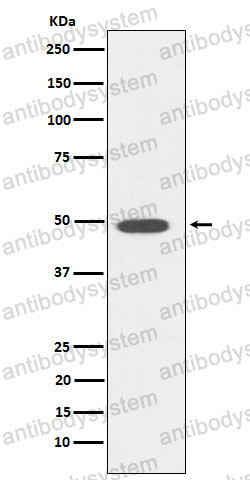
FCM, WB
Recommended Dilution
| Application |
Dilution |
| FCM |
1:20-1:100, WB: 1:1000-1:2000 |
Target
DRTF1-polypeptide 1, DRTF1, E2F dimerization partner 1, TFDP1, DP1, Transcription factor Dp-1
Concentration
1 mg/ml
Endotoxin level
Please contact with the lab for this information.
Purity
>95% by SDS-PAGE.
Purification
Protein A/G purified from cell culture supernatant.
Accession
Q14186
Form
Liquid
Storage buffer
0.01M PBS, pH 7.4, 0.05% BSA, 50% Glycerol, 0.05% Sodium azide.
Stability and Storage
Use a manual defrost freezer and avoid repeated freeze thaw cycles. Store at 4 ℃ for frequent use. Store at -20 ℃ for twelve months from the date of receipt.
Clone ID
R2F24
Note
For research use only.
Adenovirus E1a prevents the retinoblastoma gene product from complexing with a cellular transcription factor., PMID:1710781
Cloning and characterization of E2F-2, a novel protein with the biochemical properties of transcription factor E2F., PMID:8246995
The adenovirus E4-6/7 protein transactivates the E2 promoter by inducing dimerization of a heteromeric E2F complex., PMID:8289811
E2F-4, a new member of the E2F gene family, has oncogenic activity and associates with p107 in vivo., PMID:7958925
E2F-4 switches from p130 to p107 and pRB in response to cell cycle reentry., PMID:8657117
Modulation of E2F activity via signaling through surface IgM and CD40 receptors in WEHI-231 B lymphoma cells., PMID:9545352
A novel E2F binding protein with Myc-type HLH motif stimulates E2F-dependent transcription by forming a heterodimer., PMID:9780002
Modulation of E2F activity in primary mouse B cells following stimulation via surface IgM and CD40 receptors., PMID:10540350
Distinct cellular factors regulate the c-myb promoter through its E2F element., PMID:10567569
[Preparation of the polypeptide antibody against human transcriptional factors TFDP1 and TFDP3]., PMID:18782520
Comprehensive characterization of the DNA amplification at 13q34 in human breast cancer reveals TFDP1 and CUL4A as likely candidate target genes., PMID:19995430

 For research use only. Not for human or drug use.


