Catalog No.
YHA92301
Description
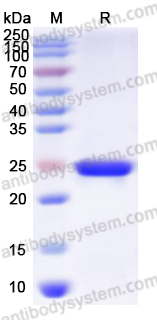
Recombinant Human ACSL4 Protein, N-His (YHA92301) is expressed in E. coli and spans Lys500-Lys711. His-tagged for convenient purification and detection, this protein is suitable for ELISA, immunogen, WB and ongoing bioactivity testing. Purity: >90% by SDS-PAGE.
Product Features
● Human ACSL4 Partial Protein — Lys500-Lys711
● Prokaryotic Expression — High yield and stable protein properties
● High Purity — Verified >90% by SDS-PAGE
● Reliable Performance — Stable batch consistency and repeatability
● Research Applications — WB, ELISA, Immunogen, SDS-PAGE, bioactivity detection and related mechanism research
Expression system
E. coli
Species
Homo sapiens (Human)
Protein length
Lys500-Lys711
Predicted molecular weight
26.38 kDa
Nature
Recombinant
Applications
ELISA, Immunogen, SDS-PAGE, WB, Bioactivity testing in progress
Endotoxin level
Please contact with the lab for this information.
Purity
>90% as determined by SDS-PAGE.
Accession
O60488
Form
Lyophilized
Storage buffer
Lyophilized from a solution in PBS pH 7.4, 1mM EDTA, 4% Trehalose, 1% Mannitol.
Reconstitution
Reconstitute in sterile water for a stock solution.
Shipping
In general, proteins are provided as lyophilized powder/frozen liquid. They are shipped out with dry ice/blue ice unless customers require otherwise.
Stability and Storage
Use a manual defrost freezer and avoid repeated freeze thaw cycles. Store at 2 to 8°C for frequent use. Store at -20 to -80°C for twelve months from the date of receipt.
Alternative Names
ACS4, ACSL4, Long-chain-fatty-acid--CoA ligase 4, LACS 4, Arachidonate--CoA ligase, FACL4, Long-chain acyl-CoA synthetase 4, LACS4
Background
Recombinant Human ACSL4 Protein, N-His (YHA92301), ACSL4 is a key long-chain acyl-CoA synthetase that preferentially activates arachidonic acid and polyunsaturated fatty acids. It drives lipid peroxidation and acts as a core regulator of ferroptosis. Widely involved in lipid metabolism, inflammatory response and tumor progression, ACSL4 serves as a critical biomarker and therapeutic target for ferroptosis mechanism study and anti-tumor drug development.
Note
For research use only.
F-box only protein 10 protects against kidney tubulointerstitial fibrosis by inhibiting ACSL4-mediated lipid peroxidation and ferroptosis., PMID:40311989
Identification of fatty acid metabolism hub genes in endometriosis using integrative bioinformatics analysis., PMID:40313549
Effect of SEMA3F on proliferation, migration and ferroptosis of endometrial stromal cells in patients with endometriosis., PMID:40319865
Ability of SPP1 to Alleviate Post-Intracerebral Hemorrhage Ferroptosis via Nrf2/HO1 Pathway., PMID:40321093
FB1 causes barrier damage to vascular endothelial cells through ferroptosis by a PINK1/Parkin mediated mitophagy-dependent mechanism., PMID:40324642
Ferroptosis and necroptosis may be involved in the formation and progression of hydrofluoric acid burn wounds: Results from an RNA-Seq analysis., PMID:40327971
CD36 Induces Inflammation by Promoting Ferroptosis in Pancreas, Epididymal Adipose Tissue, and Adipose Tissue Macrophages in Obesity-Related Severe Acute Pancreatitis., PMID:40331957
Inhibition of ACSL4 Attenuates Behavioral Deficits by Regulating Ferroptosis in a Murine Model of Systemic Lupus Erythematosus., PMID:40332005
SARS-CoV-2 N protein interacts with SLC7A11 to cause ferroptosis in acute lung injury., PMID:40342111
Heat shock protein B1-mediated ferroptosis regulates mitochondrial dysfunction in adipose tissue of ketotic dairy cows., PMID:40348370
Aerobic exercise alleviates doxorubicin-induced cardiotoxicity via inhibition of ferroptosis., PMID:40349681
[Huotan Jiedu Tongluo Decoction inhibits ferroptosis by regulating Nrf2/GPX4 pathway to ameliorate atherosclerotic lesions in ApoE~(-/-) mice]., PMID:40350883
[Glutathione-rich yeast extract inhibits EtOH-induced ferroptosis of HepG2 cells by activation of nuclear factorer-related actor 2]., PMID:40355335
Autophagy Impairment-Derived SQSTM1 Accumulation Promotes Ferroptosis in Corneal Epithelial Cells Through ACSL4 in Dry Eye., PMID:40358583
Gut microbiota-derived glutathione from metformin treatment alleviates intestinal ferroptosis induced by ischemia/reperfusion., PMID:40361123
Parkin inhibits iron overload-induced cardiomyocyte ferroptosis by ubiquitinating ACSL4 and modulating PUFA-phospholipids metabolism., PMID:40370554
Auricular Transcutaneous Vagus Nerve Stimulation Enhances Post-Stroke Neurological and Cognitive Recovery in Mice by Suppressing Ferroptosis Through α7 Nicotinic Acetylcholine Receptor Activation., PMID:40376919
The ferroptosis mediator ACSL4 fails to prevent disease progression in mouse models of MASLD., PMID:40377498
Tanshinone IIA Promotes Functional Recovery After Spinal Cord Injury by Inhibiting Neuron and Oligodendrocyte Ferroptosis Through the GPX4/ACSL4 Axis., PMID:40377778
Palmitic acid enhances the sensitivity of ferroptosis via endoplasmic reticulum stress mediated the ATF4/TXNIP Axis in polycystic ovary syndrome., PMID:40393214
The effect of lactate dehydrogenase B and its mediated histone lactylation on chondrocyte ferroptosis during osteoarthritis., PMID:40394653
COP1 drives renal cell carcinoma progression by targeting ACSL4 for ubiquitin-mediated degradation and inhibiting ferroptosis., PMID:40395328
Circ_0002638 drives squamous cell lung cancer (LUSC) progression and chemotherapy resistance by inhibiting ferroptosis via SENP1-mediated deSUMOylation of ACSL4., PMID:40398732
Ferroptosis Contributes to Retinal Ganglion Cell Loss in GLAST Knockout Mouse Model of Normal Tension Glaucoma., PMID:40402516
Therapeutic time window of sodium of Danshensu on cerebral ischemia and its mechanism of inhibiting oxidative stress and ferroptosis through Nrf2 pathway., PMID:40403934
The therapeutic potential of irisin in alleviating acute lung injury via inflammation and ferroptosis modulation., PMID:40406908
Ferroptosis effects and behavioral changes associated with high accumulation and low elimination percentage of silver in brain following a 28-day nasal instillation of silver nanoparticles in mice., PMID:40409664
BaZiBuShen inhibition of oocyte ferroptosis in primordial follicles through activation of NF2-YAP pathway for the treatment of chemotherapy-induced premature ovarian insufficiency., PMID:40412775
Apigenin Inhibits Cell Ferroptosis by Activating the PI3K/Akt Pathway and Alleviates Renal Injury Caused by Hypertension., PMID:40416644
Gastrodia protects HT22 cells from damage caused by oxygen glucose deprivation and reperfusion through inhibiting ferroptosis., PMID:40425648
Deciphering the Role of Ferroptosis in the Pathogenesis of Peripheral Artery Disease Myopathy., PMID:40427725
Infectious Spleen and Kidney Necrosis Virus Triggers Ferroptosis in CPB Cells to Enhance Virus Replication., PMID:40431724
Ginkgolide B inhibits ferroptosis in PC12 cells and ameliorates the oxidative stress in spinal cord injury through activating Nrf2 signaling pathway., PMID:40436481
Acute mountain sickness prediction: a concerto of multidimensional phenotypic data and machine learning strategies in the framework of predictive, preventive, and personalized medicine., PMID:40438497
Capsaicin induces ferroptosis via suppression of SLC7A11 activity and upregulation of ACSL4 mediated by AMPK in tongue squamous cell carcinoma., PMID:40438695
Melatonin Alleviates Erastin-Induced Cell Death by Inhibiting Ferroptosis and Amyloid Precursor Protein Processing in Neuronal Cell Lines., PMID:40442550
March6 Protects Against Acute Kidney Injury by Suppressing Renal Tubular Epithelial Cell Ferroptosis Through the Destabilization of P53 and ACSL4 Proteins., PMID:40445517
CRISPR screen reveals a simultaneous targeted mechanism to reduce cancer cell selenium and increase lipid oxidation to induce ferroptosis., PMID:40445760
Discovery of novel genipin derivatives as highly selective ferroptosis inducers for the treatment of triple-negative breast cancer., PMID:40446585
A Novel Flavonoid Derivative of Icariside II (YS-10) Improves Erectile Dysfunction in a Diabetic Rat Model by Inhibiting Ferroptosis via Activation of the Nrf2/HO-1/GPX4 Pathway., PMID:40453214
Metabolism and Mendelian randomization study on the mechanism of Buyang Huanwu Decoction in regulating iron metabolism and improving cerebral ischemia-reperfusion injury., PMID:40460920
Nrf2 Alleviates Colistin-Induced Nephrotoxicity by Suppressing Ferroptosis via GPX4-Mediated Lipid Peroxidation and Mitochondrial Protection., PMID:40474460
Pro-ferroptotic lipids as key control points for caveola formation and disassembly., PMID:40478736
Dynamic regulators of ferroptosis: Post-translational modifications in ferroptotic cell death., PMID:40482689
Empagliflozin ameliorates RSL3-induced ferroptosis in vascular endothelial cells via the NRF2/HO-1 pathway., PMID:40483457
Deciphering mitochondrial dysfunction in keratoconus: Insights into ACSL4 from machine learning-based bulk and single-cell transcriptome analyses and experimental validation., PMID:40496889
The advancement of ubiquitination regulation in apoptosis, ferroptosis, autophagy, drug resistance and treatment of cancer., PMID:40499632
Metabolic reprogramming in hepatocellular carcinoma: an integrated omics study of lipid pathways and their diagnostic potential., PMID:40500772
Inhibition of Ferroptosis Attenuates Neuron Damage and Improves Cognitive Impairment in Mice Surviving Severe Hypothermia., PMID:40507777
The Splice Variant of the NCOR2 Gene BQ323636.1 Modulates ACSL4 Expression to Enhance Fatty Acid Metabolism and Support of Tumor Growth in Breast Cancer., PMID:40507798

 For research use only. Not for human or drug use.


