
Please ensure Javascript is enabled for purposes of website accessibility
Home / Products / Research Biosimilar

Research Grade Tisotumab

Catalog #:   DHD00601 Specific References (55) DATASHEET
Host species: Human
Isotype: IgG1-kappa
Applications: Research Grade Biosimilar
Expression system: Mammalian Cells
Overview

Catalog No.

DHD00601

Expression system

Mammalian Cells

Species reactivity

Human

Host species

Human

Isotype

IgG1-kappa

Clonality

Monoclonal

Applications

Research Grade Biosimilar

Target

Tissue factor, CD142, F3, Thromboplastin, Coagulation factor III, TF

Concentration

9.33 mg/ml

Endotoxin level

Please contact with the lab for this information.

Purity

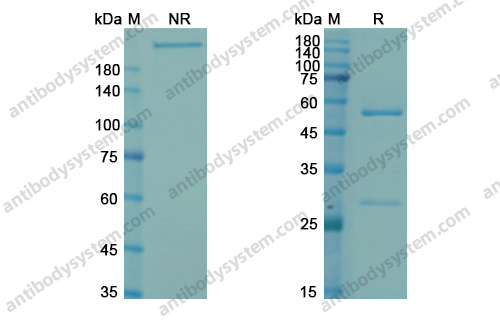
>95% as determined by SDS-PAGE.

Purification

Protein A/G purified from cell culture supernatant.

Accession

P13726

Form

Liquid

Storage buffer

100 mM Pro-Ac, 20 mM Arg, pH 5.0

Stability and Storage

Use a manual defrost freezer and avoid repeated freeze-thaw cycles. Store at 4°C short term (1-2 weeks). Store at -20°C 12 months. Store at -80°C long term.

Alternative Names

HuMax-TF-ADC, TF-011-MMAE, HuMax-TF, CAS: 1418628-81-5

Clone ID

Tisotumab

Note

For research use only. Not suitable for clinical or therapeutic use.

Data Image
  • SDS-PAGE
    SDS PAGE for Tisotumab
  • Bioactivity
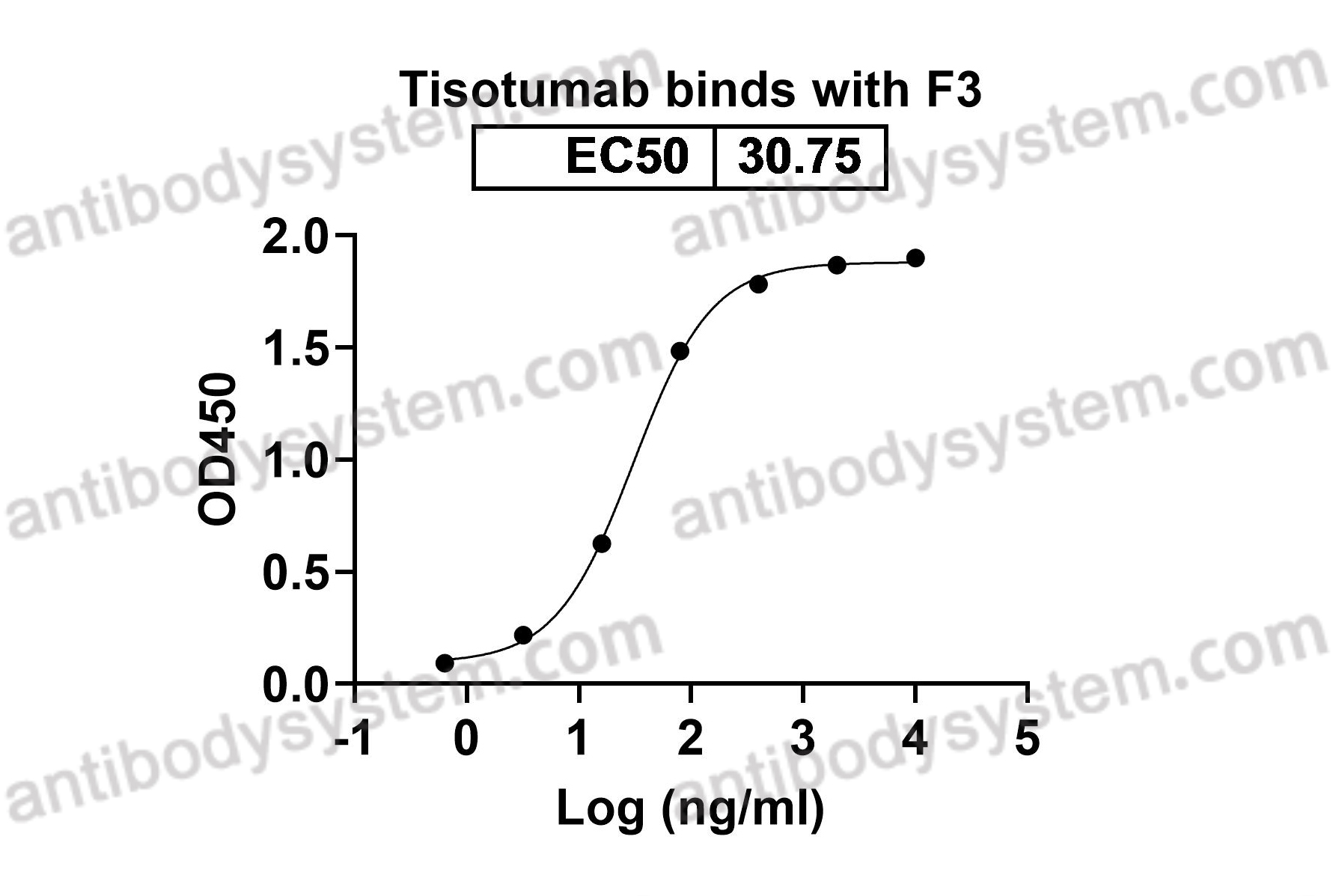
    Detects CD142/F3/TF in indirect ELISAs.
  • SEC-HPLC
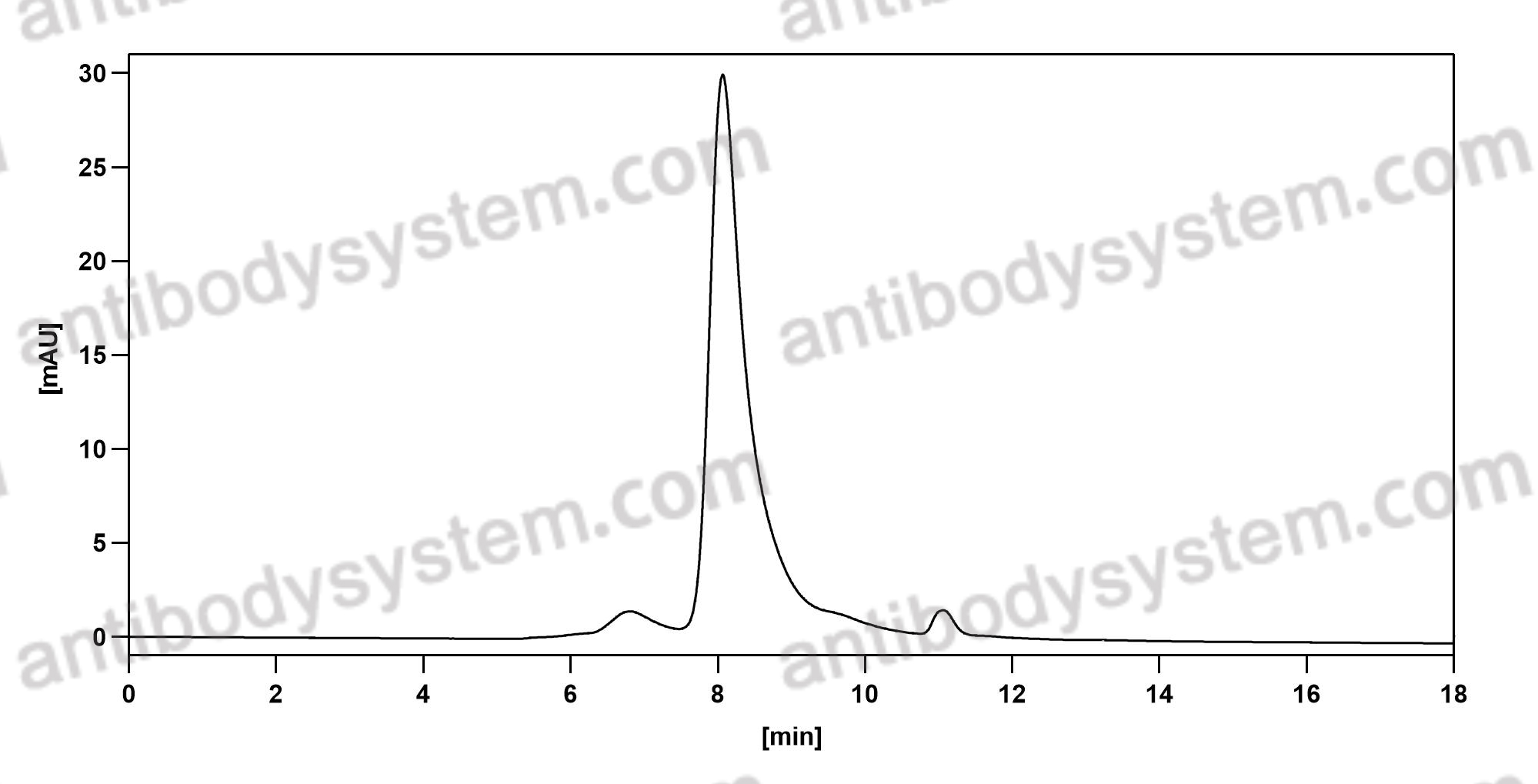
    The purity of this product is >95% as determined by SEC-HPLC.
  • Bioactivity
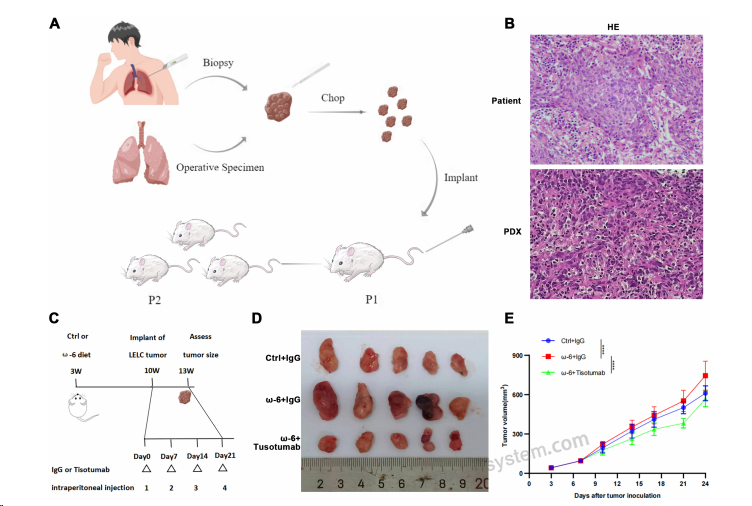
    FIGURE 3 Tisotumab reverses LA-driven pLELC progression. (A) PDX model establishment. Tumor tissues from surgery/biopsy were dissected into 2-mm³ fragments and subcutaneously implanted into nude mice via trocar. Stable models were confirmed at passage 3 (P3). (B) H&E validation of PDX model. Primary patient tumors and PDX grafts show identical histopathological features. (C) Experimental timeline. Mice received w-6 or control diets from 3 weeks of age. PDX tumors implanted at week 10; Tisotumab (4 mg/kg i.p.) or IgG administered weekly. Tissues harvested at Day 24. (D) Macroscopic tumor morphology at endpoint (Day 24). (E) Tumor growth curves. w-6 diet + IgG group exhibited significantly larger volumes vs. control (P < 0.0001), while Tisotumab suppressed w-6 diet-induced growth (P < 0.0001; two-way ANOVA).
    Data sourced from citation (PMID: 40896442)
  • Bioactivity
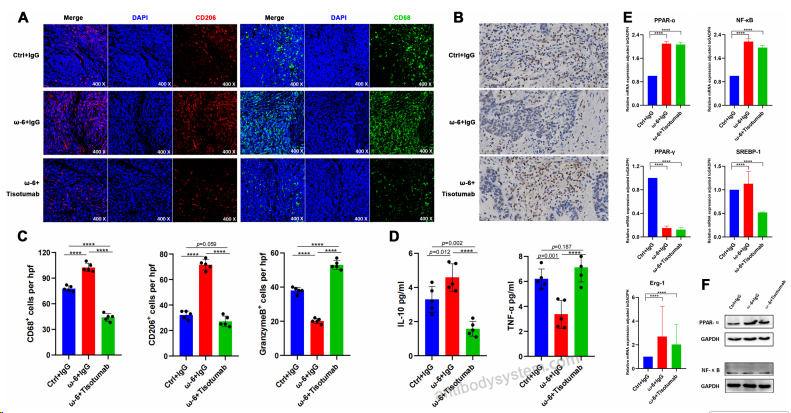
    FIGURE 4 LA promotes M2 TAM infiltration and suppresses NK cells via PPAR-a. (A) Representative IF staining of CD68 and CD206 in PDX tumors across groups. (B) IHC for Granzyme B in PDX tumors. (C) Immune cell quantification. Versus w-6 diet + IgG group, control and Tisotumab groups showed reduced CD68+, CD206+ cells and increased Granzyme B+ cells (all P < 0.0001). (D) Cytokine levels. IL-10 decreased (P = 0.012/P < 0.0001) while TNF-a increased (P = 0.001/P < 0.0001) in control and Tisotumab groups. (E) qRT-PCR analysis of transcription factors. w-6 diet upregulated PPAR a/NF-kB and downregulated PPAR-g (all P < 0.0001). No changes in SREBP-1 or Erg-1 (P > 0.05). (F) Western blot validation: w-6 diet significantly increased PPAR-a protein (P < 0.001) without altering NF-kB. **** P<0.0001.
    Data sourced from citation (PMID: 40896442)
  • Bioactivity
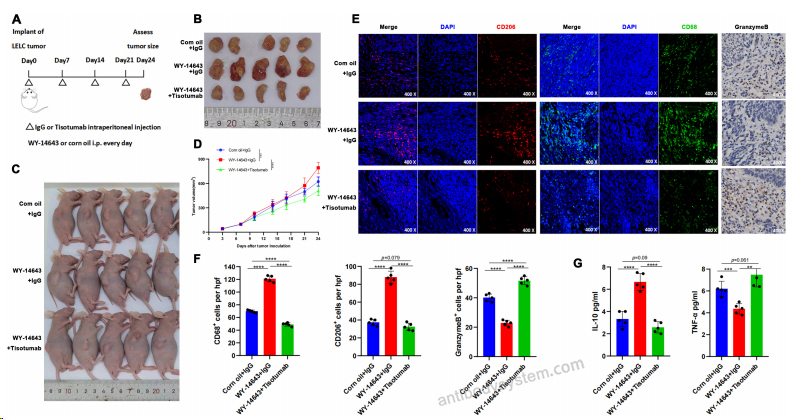
    FIGURE 5 TF Inhibitor reverses PPAR-a agonist-induced immune remodeling. (A) Timeline and treatment schedule for umor implant and assessment. PDX inoculation at 6 weeks; daily i.p. WY-14643 (100 mg/kg in corn oil) or vehicle; weekly Tisotumab or IgG; harvest at Day 24. (B) Tumor samlpes shown with varying sizes. (Day 24). (C) Schematic of mouse endpoint procedures. (D) Tumor growth curves: WY-14643 + IgG > control (P < 0.0001); Tisotumab reversed tumor growth (P < 0.0001). (E) Microscopic images displaying stained tumor sections at 400x magnification, focusing on CD206, CD68, and GranzymeB markers. (F) Bar graphs illustrating the number of CD68+, CD206+, and GranzymeB+ cells per high power field. Control and Tisotumab groups showed reduced CD68+, CD206+ cells and increased Granzyme B+ cells vs. WY-14643 + IgG (all P < 0.0001). (G) Bar graphs showing IL-10 and TNF-a levels in various treatments: reduced IL-10 (P < 0.0001) and increased TNF-a (P = 0.004/P < 0.0001) in control and Tisotumab groups. ** P<0.01, *** P<0.001, **** P<0.0001.
    Data sourced from citation (PMID: 40896442)
References

Linoleic acid drives pulmonary lymphoepithelioma-like carcinoma progression via PPAR-α/TF axis. [DHD00601]

The evolving landscape of antibody-drug conjugates in gynecologic cancers., PMID:37023499

Antibody-Drug Conjugates in Gynecologic Cancer., PMID:37229642

Tissue factor (coagulation factor III): a potential double-edge molecule to be targeted and re-targeted toward cancer., PMID:37280670

Exposure-safety and exposure-efficacy analyses for tisotumab vedotin for patients with locally advanced or metastatic solid tumors., PMID:37496366

The abscopal effect of immune-radiation therapy in recurrent and metastatic cervical cancer: a narrative review., PMID:37539054

Antibody-Drug Conjugates: A Review of Approved Drugs and Their Clinical Level of Evidence., PMID:37568702

Antibody-Drug Conjugates in Solid Tumor Oncology: An Effectiveness Payday with a Targeted Payload., PMID:37631374

Sequential Targeted Therapy for Advanced, Metastatic, and Recurrent Cervical Cancer: A Cost-Effectiveness Analysis of the Patient Journey., PMID:37646470

Tisotumab Vedotin in Combination With Carboplatin, Pembrolizumab, or Bevacizumab in Recurrent or Metastatic Cervical Cancer: Results From the innovaTV 205/GOG-3024/ENGOT-cx8 Study., PMID:37651655

Uncovering therapeutic opportunities in the clinical development of antibody-drug conjugates., PMID:37740463

Therapeutic Potential of Tisotumab Vedotin in the Treatment of Recurrent or Metastatic Cervical Cancer: A Short Report on the Emerging Data., PMID:37790898

SGN-B7H4V, an investigational vedotin ADC directed to the immune checkpoint ligand B7-H4, shows promising activity in preclinical models., PMID:37793853

New Paradigms in the Treatment of Cervical Cancer., PMID:37826852

An Antibody-Drug Conjugate Directed to Tissue Factor Shows Preclinical Antitumor Activity in Head and Neck Cancer as a Single Agent and in Combination with Chemoradiotherapy., PMID:37828725

A review of the state of cervical cancer: updates from prevention to recurrent disease., PMID:37873756

Assessing safety concerns of interstitial lung disease associated with antibody-drug conjugates: a real-world pharmacovigilance evaluation of the FDA adverse event reporting system., PMID:38100054

Antibody-Drug Conjugates in Gynecologic Cancers., PMID:38172449

Acute keratoconjunctivitis associated with tisotumab vedotin-tftv for metastatic cervical cancer., PMID:38230392

Cost-effectiveness of tisotumab vedotin as a second- or third-line therapy for cervical cancer., PMID:38330381

Recent Therapeutic Advances in Gynecologic Oncology: A Review., PMID:38398161

Cost effectiveness of immunotherapy combination therapies for endometrial cancer., PMID:38449799

Exploring tisotumab vedotin in recurrent cervical cancer: A case series including an HPV-independent gastric type adenocarcinoma., PMID:38523623

Ocular toxicities associated with antibody drug conjugates., PMID:38814581

Tisotumab vedotin (Tivdak) for cervical cancer., PMID:38905529

Tisotumab Vedotin as Second- or Third-Line Therapy for Recurrent Cervical Cancer., PMID:38959480

Tisotumab vedotin effective in recurrent cervical cancer., PMID:39039198

Accuracy and Completeness of Large Language Models About Antibody-Drug Conjugates and Associated Ocular Adverse Effects., PMID:39110155

[Antibody-Drug Conjugates in Breast Cancer and Gynecologic Cancer]., PMID:39191683

Discrepancy in PD-L1 expression between primary and metastatic tumors in two patients with recurrent cervical cancer., PMID:39252760

Pharmacovigilance study of the association between peripheral neuropathy and antibody-drug conjugates using the FDA adverse event reporting system., PMID:39271716

Anti-tissue factor antibody conjugated with monomethyl auristatin E or deruxtecan in pancreatic cancer models., PMID:39322584

Antibody drug conjugates in recurrent or metastatic cervical cancer: a focus on tisotumab vedotin state of art., PMID:39323928

Real-World Large Sample Assessment of Drug-related Dry Eye Risk: Based on the FDA Adverse Event Reporting System Database., PMID:39343068

Safety and efficacy of tisotumab vedotin with cervical cancers: A systematic review and meta-analysis., PMID:39428336

Tisotumab vedotin extravasation injury in a patient with recurrent cervical cancer., PMID:39431057

Antibody-Drug Conjugates: A Start of a New Era in Gynecological Cancers., PMID:39590153

Antibody-Drug Conjugates: The Toxicities and Adverse Effects That Emergency Physicians Must Know., PMID:39641680

Ocular adverse events associated with antibody-drug conjugates: a comprehensive pharmacovigilance analysis., PMID:39742259

Tissue factor targeted near-infrared photoimmunotherapy: a versatile therapeutic approach for malignancies., PMID:39751657

Ocular surface disease related to tisotumab vedotin-tftv., PMID:39877468

Practical clinical management of ocular adverse events related to Antibody-Drug Conjugates in gynaecological malignancies., PMID:39970828

F3 Expression Drives Sensitivity to the Antibody-Drug Conjugate Tisotumab Vedotin in Glioblastoma., PMID:40075681

Second-line antibody-drug conjugates for the treatment of metastatic human papillomavirus-independent gastric-type adenocarcinoma of cervix: The Singapore experience., PMID:40115377

Clinical applications of antibody drug conjugates for gynecologic malignancies: Review of available medicines and emerging therapeutics., PMID:40139025

PMDA regulatory update on approval and revision of the precautions for use of anticancer drugs; approval of amivantamab plus lazertinib for non-small cell lung cancer, durvalumab for small cell lung cancer, tislelizumab for esophageal cancer, tisotumab vedotin for cervical cancer, ivosidenib for leukemia, and venetoclax for lymphoma in Japan., PMID:40214878

Rapidly progressive pneumonitis days after receiving tisotumab vedotin: a new antibody-drug conjugate., PMID:40234078

The efficacy and safety of Tisotumab vedotin in the treatment of recurrent/metastatic cervical cancer: a systematic review and meta-analysis of single-arm studies., PMID:40458792

[Pharmacological characteristics of tisotumab vedotin (recombinant) (TIVDAK® 40 ‍mg Intravenous Solution) and clinical study results in recurrent or metastatic cervical cancer]., PMID:40518306

Linoleic acid promotes TF expression through PPAR-α, which leads to tumor progression in primary pulmonary lymphoepithelioma-like carcinoma. [DHD00601]

Treating Tissue Factor-Positive Cancers with Antibody-Drug Conjugates That Do Not Affect Blood Clotting, PMID: 30126944

Efficacy and safety of tisotumab vedotin in previously treated recurrent or metastatic cervical cancer (innovaTV 204/GOG-3023/ENGOT-cx6): a multicentre, open-label, single-arm, phase 2 study, PMID: 33845034

Tisotumab Vedotin Yields Responses as Second-Line Cervical Cancer Therapy, PMID: 33931438

Tisotumab vedotin in patients with advanced or metastatic solid tumours (InnovaTV 201): a first-in-human, multicentre, phase 1-2 trial, PMID: 30745090

Tisotumab Vedotin in Previously Treated Recurrent or Metastatic Cervical Cancer, PMID: 31796521

Datasheet

Document Download

Research Grade Tisotumab.pdf


$ 530
Product specifications
1 mg 530 5 mg 1590 25 mg 4130

Contact Information

Order: order@antibodysystem.com

Mail: support@antibodysystem.com

Distributor list

For research use only. Not for human or drug use.

Need help with your order?

Find out more about placing an order here

Research Grade Tisotumab [DHD00601]
Terms of sale Website terms of use Cookie policy Privacy
Copyright © 2025 AntibodySystem SAS. All Rights Reserved.            All Products are for Research Use Only