Catalog No.
YHA40701
Expression system
E. coli
Species
Homo sapiens (Human)
Protein length
Tyr390-Val647
Predicted molecular weight
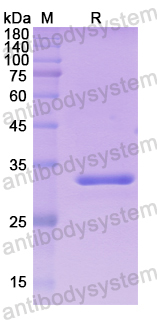
31.23 kDa
Nature
Recombinant
Applications
ELISA, Immunogen, SDS-PAGE, WB, Bioactivity testing in progress
Endotoxin level
Please contact with the lab for this information.
Purity
>90% as determined by SDS-PAGE.
Accession
O15075
Form
Lyophilized
Storage buffer
Lyophilized from a solution in PBS pH 7.4, 0.02% NLS, 1mM EDTA, 4% Trehalose, 1% Mannitol.
Reconstitution
Reconstitute in sterile water for a stock solution. A copy of datasheet will be provided with the products, please refer to it for details.
Shipping
In general, proteins are provided as lyophilized powder/frozen liquid. They are shipped out with dry ice/blue ice unless customers require otherwise.
Stability and Storage
Use a manual defrost freezer and avoid repeated freeze thaw cycles. Store at 2 to 8°C for frequent use. Store at -20 to -80°C for twelve months from the date of receipt.
Alternative Names
Doublecortin-like and CAM kinase-like 1, DCAMKL1, KIAA0369, Doublecortin-like kinase 1, DCLK1, Doublecortin domain-containing protein 3A, Serine/threonine-protein kinase DCLK1, DCDC3A
Note
For research use only.
Exosomes from metastatic colon cancer cells drive the proliferation and migration of primary colon cancer through increased expression of cancer stem cell markers CD133 and DCLK1., PMID:37487255
Proteomic investigation of neural stem cell to oligodendrocyte precursor cell differentiation reveals phosphorylation-dependent Dclk1 processing., PMID:37594553
Inferring circadian gene regulatory relationships from gene expression data with a hybrid framework., PMID:37752445
Molecular Mechanism of Mutational Disruption of DCLK1 Autoinhibition Provides a Rationale for Inhibitor Screening., PMID:37762326
Blockage of DCLK1 in cardiomyocytes suppresses myocardial inflammation and alleviates diabetic cardiomyopathy in streptozotocin-induced diabetic mice., PMID:37778481
Targeting doublecortin-like kinase 1 reveals a novel strategy to circumvent chemoresistance and metastasis in ovarian cancer., PMID:37838282
Blocking of doublecortin-like kinase 1-regulated SARS-CoV-2 replication cycle restores cell signaling network., PMID:37861336
Design, synthesis and biological evaluation of novel DCLK1 inhibitor containing purine skeleton for the treatment of pancreatic cancer., PMID:37862816
Mechanistic and evolutionary insights into isoform-specific 'supercharging' in DCLK family kinases., PMID:37883155
Role of DCLK1/Hippo pathway in type II alveolar epithelial cells differentiation in acute respiratory distress syndrome., PMID:37996782
LGR5 Expression Predicting Poor Prognosis Is Negatively Correlated with WNT5A in Colon Cancer., PMID:37998393
Epigenetic Landscape and Therapeutic Implication of Gene Isoforms of Doublecortin-Like Kinase 1 for Cancer Stem Cells., PMID:38003596
DCLK1 and its oncogenic functions: A promising therapeutic target for cancers., PMID:38007147
The doublecortin-family kinase ZYG-8DCLK1 regulates motor activity to achieve proper force balance in C. elegans acentrosomal spindles., PMID:38045228
Tuft cells are required for a rhinovirus-induced asthma phenotype in immature mice., PMID:38061015
Protein kinase D1 - A targetable mediator of pancreatic cancer development., PMID:38061566
Design and synthesis of doublecortin-like kinase 1 inhibitors and their bioactivity evaluation., PMID:38062554
Hippocampal proteomic changes in high-fat diet-induced obese mice associated with memory decline., PMID:38142716
DCLK1 is Overexpressed and Associated with Immune Cell Infiltration in Hepatocellular Carcinoma., PMID:38294590
A nasal cell atlas reveals heterogeneity of tuft cells and their role in directing olfactory stem cell proliferation., PMID:38306414
Establishment of a chicken intestinal organoid culture system to assess deoxynivalenol-induced damage of the intestinal barrier function., PMID:38369477
Discovery of a doublecortin-like kinase 1 inhibitor to prevent inflammatory responses in acute lung injury., PMID:38394920
Equine enteroid-derived monolayers recapitulate key features of parasitic intestinal nematode infection., PMID:38414039
Ehf and Fezf2 regulate late medullary thymic epithelial cell and thymic tuft cell development., PMID:38420512
Subtyping of triple-negative breast cancers: its prognostication and implications in diagnosis of breast origin., PMID:38613910
DCLK1-Mediated Regulation of Invadopodia Dynamics and Matrix Metalloproteinase Trafficking Drives Invasive Progression in Head and Neck Squamous Cell Carcinoma., PMID:38645056
Repurposing diacerein to suppress colorectal cancer growth by inhibiting the DCLK1/STAT3 signaling pathway., PMID:38658095
DCLK1 Expression and its Functional Significance in Intrahepatic Cholangiocarcinoma and Bil-IN Stage., PMID:38821583
From Inflammation to Oncogenesis: Tracing Serum DCLK1 and miRNA Signatures in Chronic Liver Diseases., PMID:38928187
A20 in hepatic stellate cells suppresses chronic hepatitis by inhibiting DCLK1-JNK pathway-dependent chemokines., PMID:38965999
Targeting the PI3K/AKT/mTOR pathway offer a promising therapeutic strategy for cholangiocarcinoma patients with high doublecortin-like kinase 1 expression., PMID:38980538
Doublecortin-like knockdown in mice attenuates obesity by stimulating energy expenditure in adipose tissue., PMID:39174821
Jiedu Xiaozheng Yin extract targets cancer stem cells by Wnt signaling pathway in colorectal cancer., PMID:39197803
E-cigarettes increase the risk of adenoma formation in murine colorectal cancer model., PMID:39253444
DCLK1 induces a pro-tumorigenic phenotype to drive gastric cancer progression., PMID:39288218
Intestinal Tuft Cells Are Enriched With Protocadherins., PMID:39360911
DCLK1 mediated cooperative acceleration of EMT by avian leukosis virus subgroup J and Marek's disease virus via the Wnt/β-catenin pathway promotes tumor metastasis., PMID:39445786
Doublecortin-like kinase 1 promotes stem cell-like properties through the Hippo-YAP pathway in prostate cancer., PMID:39781521
E-cigarettes increase the risk of adenoma formation in murine colorectal cancer model., PMID:39786590
Prostaglandin E2 and Akt Promote Stemness in Apc Mutant Dclk1+ Cells to Give Rise to Colitis-associated Cancer., PMID:39884575
Inhibition of stemness and PD-L1 expression by Pien Tze Huang enhances T cell-mediated killing of colorectal cancer., PMID:39914691
ELF1's Role in Colorectal Cancer: Up-Regulating DCLK1 Expression to Propel Malignant Progression and Stemness Features., PMID:39973554
DCLK1-mediated regulation of invadopodia dynamics and matrix metalloproteinase trafficking drives invasive progression in head and neck squamous cell carcinoma., PMID:39994636
Acute tuft cell ablation in mice induces malabsorption and alterations in secretory and immune cell lineages in the small intestine., PMID:40051209
DCLK1 in gastrointestinal cancer: A driver of tumor progression and a promising therapeutic target., PMID:40056091
Clinical significance of "S" isoform of DCLK1 in different gastric cancer subtypes using newly produced monoclonal antibody., PMID:40109216
Evolving insights into pancreatic tumor initiation and progression through DCLK1-expressing tuft cells., PMID:40132546
A Novel D-peptide modulates DCLK1 Gelsolin interactions, reducing PDAC tumor growth., PMID:40162222
Doublecortin-like kinase 1, regulated by STIP1 homology and U-box containing protein 1 or Sp1 transcription factor, affects the malignant behaviors and drug sensitivity in adriamycin-resistant breast cancer cells., PMID:40257489
Generation and functional characterization of tuft cells in non-human primate pancreatic ducts through organoid culture systems., PMID:40395933

 For research use only. Not for human or drug use.


