Catalog No.
YMA94201
Expression system
E. coli
Species
Mus musculus (Mouse)
Protein length
Ser65-Gly156
Predicted molecular weight
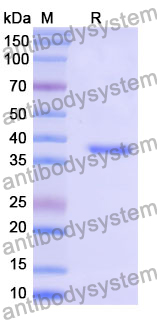
38.24 kDa
Nature
Recombinant
Applications
ELISA, Immunogen, SDS-PAGE, WB, Bioactivity testing in progress
Endotoxin level
Please contact with the lab for this information.
Purity
>90% as determined by SDS-PAGE.
Accession
O70300
Form
Lyophilized
Storage buffer
Lyophilized from a solution in PBS pH 7.4, 0.02% NLS, 1mM EDTA, 4% Trehalose, 1% Mannitol.
Reconstitution
Reconstitute in sterile water for a stock solution. A copy of datasheet will be provided with the products, please refer to it for details.
Shipping
In general, proteins are provided as lyophilized powder/frozen liquid. They are shipped out with dry ice/blue ice unless customers require otherwise.
Stability and Storage
Use a manual defrost freezer and avoid repeated freeze thaw cycles. Store at 2 to 8°C for frequent use. Store at -20 to -80°C for twelve months from the date of receipt.
Alternative Names
Persephin, PSPN, PSP
Note
For research use only.
Neuronal differentiation elicited by glial cell line-derived neurotrophic factor and ciliary neurotrophic factor in adrenal chromaffin cell line tsAM5D immortalized with temperature-sensitive SV40 T-antigen., PMID:18293415
Altered expression of neurotrophic factors in patients with major depression., PMID:18313696
Neurturin-mediated ret activation is required for retinal function., PMID:18417692
Transforming growth factor beta cooperates with persephin for dopaminergic phenotype induction., PMID:18420832
Exogenous application of persephin influences phosphatidylinositol-3 kinase and MAPK/ERK signalling and enhances proliferation during early development in retinospheres., PMID:18590797
Neurturin, a member of the glial cell line-derived neurotrophic factor family, affects the development of acetylcholinesterase-positive cells in a three-dimensional model system of retinogenesis., PMID:18673446
Postnatal roles of glial cell line-derived neurotrophic factor family members in nociceptors plasticity., PMID:18958362
Polymorphisms in the genes encoding the 4 RET ligands, GDNF, NTN, ARTN, PSPN, and susceptibility to Hirschsprung disease., PMID:18970938
Glial cell line-derived neurotrophic factor family ligands enhance capsaicin-stimulated release of calcitonin gene-related peptide from sensory neurons., PMID:19285119
Comparison of GFL-GFRalpha complexes: further evidence relating GFL bend angle to RET signalling., PMID:19478429
Persephin signaling through GFRalpha1: the potential for the treatment of Parkinson's disease., PMID:20350599
Establishment and characterization of a noradrenergic adrenal chromaffin cell line, tsAM5NE, immortalized with the temperature-sensitive SV40 T-antigen., PMID:21029049
Heparan sulfate proteoglycan syndecan-3 is a novel receptor for GDNF, neurturin, and artemin., PMID:21200028
Novel mutations at RET ligand genes preventing receptor activation are associated to Hirschsprung's disease., PMID:21206993
Amyloid-related biomarkers and axonal damage proteins in parkinsonian syndromes., PMID:21873100
Valproic acid up-regulates melatonin MT1 and MT2 receptors and neurotrophic factors CDNF and MANF in the rat brain., PMID:22243807
[Study on the stratification components of extracellular polymeric substances (EPS) in activated sludge and their variation characteristics in physicochemical properties]., PMID:23233983
Proteome-wide discovery of mislocated proteins in cancer., PMID:23674306
Granulation of biological flocs under elevated pressure: characteristics of granules., PMID:23787328
Therapeutic potential of genetically modified mesenchymal stem cells after neonatal hypoxic-ischemic brain damage., PMID:24172866
Persephin: A potential key component in human oral cancer progression through the RET receptor tyrosine kinase-mitogen-activated protein kinase signaling pathway., PMID:24375483
Formation of aerobic granular sludge under adverse conditions: low DO and high ammonia., PMID:24620612
The effect of lentivirus-mediated PSPN genetic engineering bone marrow mesenchymal stem cells on Parkinson's disease rat model., PMID:25118697
Long-term effect of low concentration Cr(VI) on P removal in granule-based enhanced biological phosphorus removal (EBPR) system., PMID:25479809
Pro-Permeability Factors After Dexamethasone Implant in Retinal Vein Occlusion; the Ozurdex for Retinal Vein Occlusion (ORVO) Study., PMID:25908486
The RET fusion gene and its correlation with demographic and clinicopathological features of non-small cell lung cancer: a meta-analysis., PMID:25975578
Does the Cerebrospinal Fluid Reflect Altered Redox State But Not Neurotrophic Support Loss in Parkinson's Disease?, PMID:26263410
HSP90 inhibition blocks ERBB3 and RET phosphorylation in myxoid/round cell liposarcoma and causes massive cell death in vitro and in vivo., PMID:26595521
Targeting the glial-derived neurotrophic factor and related molecules for controlling normal and pathologic pain., PMID:26863504
[Glial cell line-derived neurotrophic factor family ligands and their therapeutic potential]., PMID:27668599
The GDNF Family: A Role in Cancer?, PMID:29245123
Analysis of neurotrophic and antioxidant factors related to midbrain dopamine neuronal loss and brain inflammation in the cerebrospinal fluid of the elderly., PMID:29775745
[Evolution of Extracellular Polymeric Substances of the Activated Sludge with Calcium Ion Addition During Set-up Period of Sequencing Batch Reactors]., PMID:29965367
Biological treatment of selenium-laden wastewater containing nitrate and sulfate in an upflow anaerobic sludge bed reactor at pH 5.0., PMID:30098564
The Expression and Cellular Localisation of Neurotrophin and Neural Guidance Molecules in Peritoneal Ectopic Lesions., PMID:30251099
Gene Expression of Neurotrophins and Their Receptors in Keloids., PMID:30325834
The role of glial cell line-derived neurotrophic factor family member artemin in neurological disorders and cancers., PMID:32573073
Plasma membrane localization of the GFL receptor components: a nexus for receptor crosstalk., PMID:32767110
Primary hypothyroidism and autoimmune thyroiditis alter the transcriptional activity of genes regulating neurogenesis in the blood of patients., PMID:33600668
Cleavage of the Perlecan-Semaphorin 3A-Plexin A1-Neuropilin-1 (PSPN) Complex by Matrix Metalloproteinase 7/Matrilysin Triggers Prostate Cancer Cell Dyscohesion and Migration., PMID:33809984
The role of procalcitonin and presepsin in the septic febrile neutropenia in acute leukemia patients., PMID:34324506
Insight into the role of exopolysaccharide in determining the structural stability of aerobic granular sludge., PMID:34392097
Evaluation of Oxidative Stress and Inflammatory Biomarkers Pre and Post-Treatment in New Diagnosed Atherosclerotic Patients., PMID:35172655
Rapid recovery of mixed culture polyhydroxyalkanoate production system from EPS bulking using azithromycin., PMID:35247561
Homer1 promotes the conversion of A1 astrocytes to A2 astrocytes and improves the recovery of transgenic mice after intracerebral hemorrhage., PMID:35287697
Effect of salinity on removal performance of anaerobic membrane bioreactor treating azo dye wastewater., PMID:36331691
Spectroscopic fingerprints profiling the polysaccharide/protein/humic architecture of stratified extracellular polymeric substances (EPS) in activated sludge., PMID:36934542
Expression of Glial-Cell-Line-Derived Neurotrophic Factor Family Ligands in Human Intervertebral Discs., PMID:37958856
Explainable cancer factors discovery: Shapley additive explanation for machine learning models demonstrates the best practices in the case of pancreatic cancer., PMID:38342661
Survival prediction in patients with head and neck squamous cell carcinoma and novel mechanistic insights of S100A8/A9., PMID:39546127

 For research use only. Not for human or drug use.


