Catalog No.
YHC10002
Expression system
E. coli
Species
Homo sapiens (Human)
Protein length
Glu2-Asp393
Predicted molecular weight
70.34 kDa
Nature
Recombinant
Applications
ELISA, Immunogen, SDS-PAGE, WB, Bioactivity testing in progress
Endotoxin level
Please contact with the lab for this information.
Purity
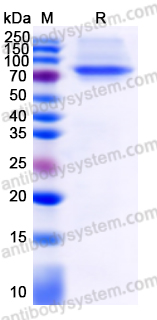
>90% as determined by SDS-PAGE.
Accession
P04637
Form
Lyophilized
Storage buffer
Lyophilized from a solution in PBS pH 7.4, 0.02% SKL, 1mM EDTA, 5% Trehalose, 2% Mannitol.
Reconstitution
Reconstitute in sterile water for a stock solution.
Shipping
In general, proteins are provided as lyophilized powder/frozen liquid. They are shipped out with dry ice/blue ice unless customers require otherwise.
Stability and Storage
Use a manual defrost freezer and avoid repeated freeze thaw cycles. Store at 2 to 8°C for frequent use. Store at -20 to -80°C for twelve months from the date of receipt.
Alternative Names
Antigen NY-CO-13, Cellular tumor antigen p53, P53, Tumor suppressor p53, TP53, Phosphoprotein p53
Note
For research use only.
Investigation of Structural Mechanisms Underlying p53 Dysfunction Caused by 148 Missense Mutations Using AlphaFold3 and Molecular Dynamics Simulations., PMID:40464633
Apoptotic effects of cold atmospheric pressure plasma on A549 and LL/2 lung carcinoma cell lines., PMID:40467678
The hydroxamate based HDAC inhibitor WMJ-J-09 induces colorectal cancer cell death by targeting tubulin and downregulating survivin., PMID:40467895
Crosstalk Between the Oncoproteins of High-Risk Human Papillomaviruses Types 16 and 18 in Colorectal Cancer Cell Models., PMID:40468102
[Mechanistic study on low expression of Ace2 gene activated senescence-related signals and promoted the progression of silicotic fibrosis in mice]., PMID:40468507
Real-world survival outcomes and MDM2 prevalence in US patients with metastatic dedifferentiated liposarcoma., PMID:40468683
Lipid Droplet-Organized MDM2-Mediated P53 Degradation: A Metabolic Switch Governing Diet-Driven Tumor Progression., PMID:40470795
Comprehensive morphological, immunohistochemical, and molecular characterization of congenital pulmonary airway malformation (CPAM)., PMID:40473982
A radiogenomics study on 18F-FDG PET/CT in endometrial cancer by a novel deep learning segmentation algorithm., PMID:40474131
Protein Kinase D Knockdown Alleviates Vascular Calcification Through P53-SLC7A11 Axis-Mediated Ferroptosis., PMID:40474563
p53 reveals principles of chromatin remodeling and enhancer activation., PMID:40479707
Assessing the influence of TP53 polymorphisms and haplotypes on bioelectrical impedance analysis parameters and nutritional status in aging Iranian population., PMID:40481964
Downregulation of Alox5 Inhibits Ferroptosis to Improve Doxorubicin-Induced Cardiotoxicity via the P53/SLC7A11 Pathway., PMID:40485049
Identification of MDM4 as a Prognostic Biomarker and a Target for Therapeutics in Colorectal Cancer., PMID:40485064
Single-Cell Transcriptomic Profiling Reveals KRAS/TP53-Driven Neutrophil Reprogramming in Luad: A Multi-Gene Prognostic Model and Therapeutic Targeting of RHOV., PMID:40486872
Targeting the JAK2-STAT3-UCHL3-ENO1 axis suppresses glycolysis and enhances the sensitivity to 5-FU chemotherapy in TP53-mutant colorectal cancer., PMID:40487654
Mechanisms Underlying the Therapeutic Effects of Brucea javanica in Cervical Cancer Treatment Based on Network Pharmacology and Molecular Docking., PMID:40487864
Corneal Sensory Denervation Causes Epithelial Ferroptosis and Delayed Healing in Mice., PMID:40488714
FOXQ1 Suppressing Apoptosis in Colorectal Cancer Cells by P53 Deacetylation., PMID:40491105
Oxindole-Coumarin Hybrids With Broad-Spectrum Anticancer Activity: Apoptosis Induction and Selective CA IX/XII Targeting., PMID:40492425
Inhibitors of p53 Apoptosis-Stimulating Protein Mitigate Acute Kidney Injury by Modulating the HIF-1α/SLC7A11 Pathway to Suppress Ferroptosis., PMID:40492946
[DICER1-mutant primary intracranial sarcoma: analysis of five cases]., PMID:40494768
Progress of p53 Involvement in Central Nervous System Diseases and Targeted Drug Discovery., PMID:40495443
P53-Induced Autophagy Degradation of NKX3-2 Improves Ovarian Cancer Prognosis., PMID:40497941
R-2-hydroxyglutarate-mediated inhibition of KDM4A compromises telomere integrity., PMID:40498073
HNMT Promotes the Occurrence and Progression of Nasopharyngeal Carcinoma by Inhibiting the IFN/TXNIP/p53 Axis., PMID:40498422
Transglutaminase 2-mediated glutamine deamidation enhances p21 stability during senescence., PMID:40498452
Molecular patterns and mechanisms of tumorigenesis in HPV-associated and HPV-independent sinonasal squamous cell carcinoma., PMID:40500270
Generation and characterization of a mouse model of conditional Chd4 knockout in the endometrial epithelium., PMID:40501592
AURKA inhibition amplifies DNA replication stress to foster WEE1 kinase dependency and synergistic antitumor effects with WEE1 inhibition in cancers., PMID:40501675
Loss of tumor suppressor p53 upregulates stem cell factor SOX9 via Notch signaling., PMID:40501825
Defining CDK12 as a tumor suppressor and therapeutic target in mouse models of tubo-ovarian high-grade serous carcinoma., PMID:40504161
Hereditary breast cancer beyond BRCA: clinicopathological characteristics and long-term outcomes., PMID:40504267
TAp73 as a potential key for understanding male infertility: a mini-review., PMID:40504304
The role of HSPB1 in modulating ferroptosis in pancreatic cancer via the TP53/SLC7A11/GPX4 axis., PMID:40504332
Structural dynamics of the wild-type p53 DNA-binding domain and hotspot mutants reveal oncogenic conformational shifts., PMID:40504558
Integrating metabolomics and network pharmacology analysis provides new insights into the lipid metabolism disorder of Abrus mollis., PMID:40505757
DNA damage response inhibition is an early event in cadmium-induced breast carcinogenesis., PMID:40505819
RNF216 inhibits ferroptosis in lung adenocarcinoma by promoting p53 ubiquitination., PMID:40506397
Anticancer potential of eugenol in hepatocellular carcinoma through modulation of oxidative stress, inflammation, apoptosis, and proliferation mechanisms., PMID:40506614
The Role of Hydrogen Sulfide in the Localization and Structural-Functional Organization of p53 Following Traumatic Brain Injury: Development of a YOLO Model for Detection and Quantification of Apoptotic Nuclei., PMID:40507878
Mutational Patterns in Colorectal Cancer: Do PDX Models Retain the Heterogeneity of the Original Tumor?, PMID:40507920
Glucosylceramide Synthase, a Key Enzyme in Sphingolipid Metabolism, Regulates Expression of Genes Accounting for Cancer Drug Resistance., PMID:40507922
Alterations in the Expression of a Set of miRNAs in Endometrial Cancer and Their Correlation with Clinical Variables and the p53 Signaling Pathway., PMID:40508024
Mutant p53 Associates with Human Equilibrative Nucleoside 1 Upregulation and Better Response to Adjuvant Gemcitabine in Intrahepatic Cholangiocarcinoma Patients., PMID:40508069
The Intrabody Against Murine Double Minute 2 via a p53-Dependent Pathway Induces Apoptosis of Cancer Cell., PMID:40508092
Integrating Aggressive-Variant Prostate Cancer-Associated Tumor Suppressor Gene Status with Clinical Variables to Refine Prognosis and Predict Androgen Receptor Pathway Inhibitor Response in Metastatic Hormone-Sensitive Setting., PMID:40508118
Genetic Markers as Predictors of Prognosis and Treatment Response in Patients with Oral Cancer: A Prospective Study., PMID:40511136
SASH1 Mutations and Hereditary Disorders of Pigmentation: Review of Literature., PMID:40511878
The puzzling regulation of the interferon signaling system by the p53 tumor suppressor protein., PMID:40512405

 For research use only. Not for human or drug use.


