Catalog No.
YHC90901
Expression system
E. coli
Species
Homo sapiens (Human)
Protein length
Met1-Leu318
Predicted molecular weight
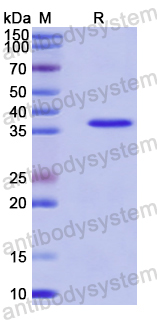
36.93 kDa
Nature
Recombinant
Applications
ELISA, Immunogen, SDS-PAGE, WB, Bioactivity testing in progress
Endotoxin level
Please contact with the lab for this information.
Purity
>90% as determined by SDS-PAGE.
Accession
P11908
Form
Lyophilized
Storage buffer
Lyophilized from a solution in PBS pH 7.4, 0.02% NLS, 1mM EDTA, 4% Trehalose, 1% Mannitol.
Reconstitution
Reconstitute in sterile water for a stock solution. A copy of datasheet will be provided with the products, please refer to it for details.
Shipping
In general, proteins are provided as lyophilized powder/frozen liquid. They are shipped out with dry ice/blue ice unless customers require otherwise.
Stability and Storage
Use a manual defrost freezer and avoid repeated freeze thaw cycles. Store at 2 to 8°C for frequent use. Store at -20 to -80°C for twelve months from the date of receipt.
Alternative Names
PRS-II, PPRibP, Phosphoribosyl pyrophosphate synthase II, Ribose-phosphate pyrophosphokinase 2, PRPS2
Note
For research use only.
Localization of human phosphoribosylpyrophosphate synthetase subunit I and II genes (PRPS1 and PRPS2) to different regions of the X chromosome and assignment of two PRPS1-related genes to autosomes., PMID:2536962
Physical mapping of loci in the distal half of the short arm of the human X chromosome: implications for the spreading of X-chromosome inactivation., PMID:1315458
Promoter regions of the human X-linked housekeeping genes PRPS1 and PRPS2 encoding phosphoribosylpyrophosphate synthetase subunit I and II isoforms., PMID:1314091
Molecular design of photosynthesis-elevated chloroplasts for mass accumulation of a foreign protein., PMID:18222961
Direct role of nucleotide metabolism in C-MYC-dependent proliferation of melanoma cells., PMID:18677108
HuR is a post-transcriptional regulator of core metabolic enzymes in pancreatic cancer., PMID:23807417
Protein and nucleotide biosynthesis are coupled by a single rate-limiting enzyme, PRPS2, to drive cancer., PMID:24855946
Proteomic analysis on infantile spasm and prenatal stress., PMID:24994451
Meta-analysis of GWAS on two Chinese populations followed by replication identifies novel genetic variants on the X chromosome associated with systemic lupus erythematosus., PMID:25149475
Expression of phosphoribosyl pyrophosphate synthetase genes in U87 glioma cells with ERN1 knockdown: effect of hypoxia and endoplasmic reticulum stress., PMID:25816608
PRPS2 Expression Correlates with Sertoli-Cell Only Syndrome and Inhibits the Apoptosis of TM4 Sertoli Cells., PMID:26004865
Arginylation regulates purine nucleotide biosynthesis by enhancing the activity of phosphoribosyl pyrophosphate synthase., PMID:26175007
Novel drug targets for personalized precision medicine in relapsed/refractory diffuse large B-cell lymphoma: a comprehensive review., PMID:26654227
MYCN promotes neuroblastoma malignancy by establishing a regulatory circuit with transcription factor AP4., PMID:27448979
A Critical Role of Glutamine and Asparagine γ-Nitrogen in Nucleotide Biosynthesis in Cancer Cells Hijacked by an Oncogenic Virus., PMID:28811348
Conversion of PRPS Hexamer to Monomer by AMPK-Mediated Phosphorylation Inhibits Nucleotide Synthesis in Response to Energy Stress., PMID:29074724
Presumptive BSE cases with an aberrant prion protein phenotype in Switzerland, 2011: Lack of prion disease in experimentally inoculated cattle and bovine prion protein transgenic mice., PMID:29675959
Targeted Quantitative Kinome Analysis Identifies PRPS2 as a Promoter for Colorectal Cancer Metastasis., PMID:30908912
Therapy-induced mutations drive the genomic landscape of relapsed acute lymphoblastic leukemia., PMID:31697823
Phosphoribosyl-pyrophosphate synthetase 2 (PRPS2) depletion regulates spermatogenic cell apoptosis and is correlated with hypospermatogenesis., PMID:31736475
Phosphoribosyl pyrophosphate synthetases 2 knockdown inhibits prostate cancer progression by suppressing cell cycle and inducing cell apoptosis., PMID:31956349
Apocrine glands are bystanders in hidradenitis suppurativa and their involvement is gender specific., PMID:32031713
Molecular mechanism of c-Myc and PRPS1/2 against thiopurine resistance in Burkitt's lymphoma., PMID:32391636
Nucleotide de novo synthesis increases breast cancer stemness and metastasis via cGMP-PKG-MAPK signaling pathway., PMID:33186350
[Expression of phosphoribosyl pyrophosphate synthase 2 in human testis tissue]., PMID:33346415
PRPS1-mediated purine biosynthesis is critical for pluripotent stem cell survival and stemness., PMID:33493137
Role of PRPS2 as a prognostic and therapeutic target in osteosarcoma., PMID:33589531
PRPS2 Enhances Resistance to Cisplatin via Facilitating Exosomes-mediated Macrophage M2 Polarization in Non-small Cell Lung Cancer., PMID:34251965
Proteome and transcriptome explore the mechanism of Salvia miltiorrhiza polysaccharides to relieve florfenicol-induced kidney injury in broilers., PMID:35150422
Identification and Functional Analyses of Host Proteins Interacting with the p17 Protein of Avian Reovirus., PMID:35632635
Dietary intake of fructose increases purine de novo synthesis: A crucial mechanism for hyperuricemia., PMID:36601078
Structural basis of human PRPS2 filaments., PMID:37248548
Association of genetic variation on X chromosome with systemic lupus erythematosus in both Thai and Chinese populations., PMID:38458775
The temporal protein signature analyses of developing human deciduous molar tooth germ., PMID:38522031
Regulatory mechanism and expression level of PRPS2 in lung cancer., PMID:38736292
PRPS2-mediated modulation of the antitumor immune response in lung cancer through CCL2-mediated tumor-associated macrophages and myeloid-derived suppressor cells., PMID:38952044
Evolutionary origins and innovations sculpting the mammalian PRPS enzyme complex., PMID:39411161
Host protein PRPS2 interact with the non-structural protein p17 of Avian Reovirus and promote viral replication., PMID:39631276
PRPS2 enhances RNA m6A methylation by stimulating SAM synthesis through enzyme-dependent and independent mechanisms., PMID:40295500

 For research use only. Not for human or drug use.


