Catalog No.
YHK55801
Expression system
E. coli
Species
Homo sapiens (Human)
Protein length
Asn626-Gly816
Predicted molecular weight
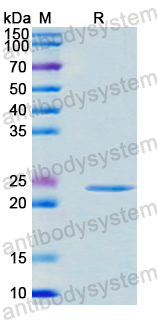
23.00 kDa
Nature
Recombinant
Applications
ELISA, Immunogen, SDS-PAGE, WB, Bioactivity testing in progress
Endotoxin level
Please contact with the lab for this information.
Purity
>90% as determined by SDS-PAGE.
Accession
Q8WUF5
Form
Lyophilized
Storage buffer
Lyophilized from a solution in PBS pH 7.4, 0.02% NLS, 1mM EDTA, 4% Trehalose, 1% Mannitol.
Reconstitution
Reconstitute in sterile water for a stock solution. A copy of datasheet will be provided with the products, please refer to it for details.
Shipping
In general, proteins are provided as lyophilized powder/frozen liquid. They are shipped out with dry ice/blue ice unless customers require otherwise.
Stability and Storage
Use a manual defrost freezer and avoid repeated freeze thaw cycles. Store at 2 to 8°C for frequent use. Store at -20 to -80°C for twelve months from the date of receipt.
Alternative Names
IASPP, Inhibitor of ASPP protein, NKIP1, RAI, NFkB-interacting protein 1, PPP1R13BL, RelA-associated inhibitor, Protein iASPP, PPP1R13L, PPP1R13B-like protein
Note
For research use only.
Enhanced expressions of FHL2 and iASPP predict poor prognosis in acute myeloid leukemia., PMID:29910468
MiR-340/iASPP axis affects UVB-mediated retinal pigment epithelium (RPE) cell damage., PMID:29982095
miR-129 targets CDK1 and iASPP to modulate Burkitt lymphoma cell proliferation in a TAp63-dependent manner., PMID:30105797
GLTSCR1, ATM, PPP1R13L and CD3EAP Genetic Variants and Lung Cancer Risk in a Chinese Population., PMID:30128886
A targeted next-generation gene panel reveals a novel heterozygous nonsense variant in the TP63 gene in patients with arrhythmogenic cardiomyopathy., PMID:30453078
Rs3212986 polymorphism, a possible biomarker to predict smoking-related lung cancer, alters DNA repair capacity via regulating ERCC1 expression., PMID:30453383
Epigenetic Regulation of iASPP-p63 Feedback Loop in Cutaneous Squamous Cell Carcinoma., PMID:30710576
Identification of key regulatory genes connected to NF-κB family of proteins in visceral adipose tissues using gene expression and weighted protein interaction network., PMID:31013288
iASPP mediates p53 selectivity through a modular mechanism fine-tuning DNA recognition., PMID:31395738
Flexible Tethering of ASPP Proteins Facilitates PP-1c Catalysis., PMID:31402222
Sensitivity of ASPP and P-gp to neoadjuvant chemotherapy combined with gene therapy in locally advanced cervical cancer., PMID:31424649
Methylation status of the PPP1R13L promoter region among lung cancer patients and healthy controls. Analytical cross-sectional study., PMID:31483011
Downregulation of iASPP Expression Suppresses Proliferation, Invasion and Increases Chemosensitivity to Paclitaxel of Head and Neck Squamous Cell Carcinoma In Vitro., PMID:31601301
Overexpression of iASPP is required for autophagy in response to oxidative stress in choriocarcinoma., PMID:31615473
Race-specific alterations in DNA methylation among middle-aged African Americans and Whites with metabolic syndrome., PMID:31739726
CDK9 inhibitors reactivate p53 by downregulating iASPP., PMID:31866490
iASPP-Mediated ROS Inhibition Drives 5-Fu Resistance Dependent on Nrf2 Antioxidative Signaling Pathway in Gastric Adenocarcinoma., PMID:31938994
A previously identified apoptosis inhibitor iASPP confers resistance to chemotherapeutic drugs by suppressing senescence in cancer cells., PMID:32005663
Targeting an Interaction Between Two Disordered Domains by Using a Designed Peptide., PMID:32181542
Inhibitor of apoptosis-stimulating protein of p53 inhibits ferroptosis and alleviates intestinal ischemia/reperfusion-induced acute lung injury., PMID:32203170
Conditional Up-Regulation of SERCA2a Exacerbates RyR2-Dependent Ventricular and Atrial Arrhythmias., PMID:32260593
Ubiquitin ligase CHAF1B induces cisplatin resistance in lung adenocarcinoma by promoting NCOR2 degradation., PMID:32508530
Biallelic variants in PPP1R13L cause paediatric dilated cardiomyopathy., PMID:32666529
Interaction between common variants of MDM2 and PPP1R13L and CD3EAP and TP53 SNPs in relation to lung cancer risk among Chinese., PMID:32953734
iASPP protects the heart from ischemia injury by inhibiting p53 expression and cardiomyocyte apoptosis., PMID:33128543
Upregulation of iASPP ameliorates hypoxia/reoxygenation-induced apoptosis and oxidative stress in cardiomyocytes by upregulating Nrf2 signaling., PMID:33332723
TP53 common variants and interaction with PPP1R13L and CD3EAP SNPs and lung cancer risk and smoking behavior in a Chinese population., PMID:35351459
Proteomic Analysis Uncovers Measles Virus Protein C Interaction With p65-iASPP Protein Complex., PMID:33515806
Malignant transformation of human bronchial epithelial cells induced by benzo [a] pyrene suggests a negative feedback of TP53 to PPP1R13L via binding a possible enhancer element., PMID:34610339
iASPP contributes to cell cortex rigidity, mitotic cell rounding, and spindle positioning., PMID:34705028
iASPP suppresses Gp78-mediated TMCO1 degradation to maintain Ca2+ homeostasis and control tumor growth and drug resistance., PMID:35121659
iASPP is essential for HIF-1α stabilization to promote angiogenesis and glycolysis via attenuating VHL-mediated protein degradation., PMID:35169254
Chitosan-Gelatin-EGCG Nanoparticle-Meditated LncRNA TMEM44-AS1 Silencing to Activate the P53 Signaling Pathway for the Synergistic Reversal of 5-FU Resistance in Gastric Cancer., PMID:35717675
Novel PPP1R13L variant expands the phenotype of a rare cardiocutaneous syndrome., PMID:35924320
Novel homozygous stop-gain pathogenic variant of PPP1R13L gene leads to arrhythmogenic cardiomyopathy., PMID:35933355
Mutant Ras and inflammation-driven skin tumorigenesis is suppressed via a JNK-iASPP-AP1 axis., PMID:36261000
Proteomics and bioinformatics analysis of cardiovascular related proteins in offspring exposed to gestational diabetes mellitus., PMID:36277748
Transcription factor SP1 and oncoprotein PPP1R13L regulate nicotine-induced epithelial-mesenchymal transition in lung adenocarcinoma via a feedback loop., PMID:36372331
Identification of immune- and autophagy-related genes and effective diagnostic biomarkers in endometriosis: a bioinformatics analysis., PMID:36660690
Common variants of pro-inflammatory gene IL1B and interactions with PPP1R13L and POLR1G in relation to lung cancer among Northeast Chinese., PMID:37147350
p53 inhibitor iASPP is an unexpected suppressor of KRAS and inflammation-driven pancreatic cancer., PMID:37270580
Variable phenotype of a null PPP1R13L allele in children with dilated cardiomyopathy., PMID:37698259
Human colorectal cancer: upregulation of the adaptor protein Rai in TILs leads to cell dysfunction by sustaining GSK-3 activation and PD-1 expression., PMID:38175205
Impact of Protein Phosphatase Expressions on the Prognosis of Hepatocellular Carcinoma Patients., PMID:38463290
Labeled-free quantitative proteomic analysis of cervical squamous cell carcinoma identifies potential protein biomarkers., PMID:38952985
An Extended Phenotype of PPP1R13L Cardiocutaneous Syndrome., PMID:39579152
High iASPP (PPP1R13L) expression is an independent predictor of adverse clinical outcome in acute myeloid leukemia (AML)., PMID:39616159
Alternative splicing in the DBD linker region of p63 modulates binding to DNA and iASPP in vitro., PMID:39762243
PPP1R13L drives cervical cancer progression by suppressing p63-mediated PTEN transcription., PMID:40014097
Exploring the lncRNA NEAT1/iASPP Pathway in Chordoma: Mechanisms of Proliferation Suppression and Apoptosis Induction., PMID:40287808

 For research use only. Not for human or drug use.


