Catalog No.
YHK53801
Expression system
E. coli
Species
Homo sapiens (Human)
Protein length
Pro298-Gly711
Predicted molecular weight
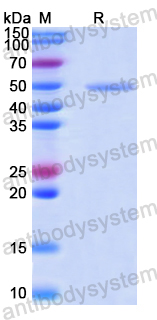
50.18 kDa
Nature
Recombinant
Applications
ELISA, Immunogen, SDS-PAGE, WB, Bioactivity testing in progress
Endotoxin level
Please contact with the lab for this information.
Purity
>90% as determined by SDS-PAGE.
Accession
Q92835
Form
Lyophilized
Storage buffer
Lyophilized from a solution in PBS pH 7.4, 0.02% NLS, 1mM EDTA, 4% Trehalose, 1% Mannitol.
Reconstitution
Reconstitute in sterile water for a stock solution. A copy of datasheet will be provided with the products, please refer to it for details.
Shipping
In general, proteins are provided as lyophilized powder/frozen liquid. They are shipped out with dry ice/blue ice unless customers require otherwise.
Stability and Storage
Use a manual defrost freezer and avoid repeated freeze thaw cycles. Store at 2 to 8°C for frequent use. Store at -20 to -80°C for twelve months from the date of receipt.
Alternative Names
Inositol polyphosphate-5-phosphatase D, p150Ship, hp51CN, INPP5D, SH2 domain-containing inositol 5'-phosphatase 1, SHIP, SHIP1, Phosphatidylinositol 3,4,5-trisphosphate 5-phosphatase 1, SHIP-1, SIP-145, Phosphatidylinositol 4,5-bisphosphate 5-phosphatase, SH2 domain-containing inositol phosphatase 1, Inositol polyphosphate-5-phosphatase of 145 kDa
Note
For research use only.
Manifestations of Alzheimer's disease genetic risk in the blood are evident in a multiomic analysis in healthy adults aged 18 to 90., PMID:35413975
JAK2-V617F is a negative regulation factor of SHIP1 protein and thus influences the AKT signaling pathway in patients with Myeloproliferative neoplasm (MPN)., PMID:35609769
TIGIT as a Novel Prognostic Marker for Immune Infiltration in Invasive Breast Cancer., PMID:35770416
MicroRNA-155 expression is associated with pulpitis progression by targeting SHIP1., PMID:35834034
Parkinson's Disease rs117896735 Variant Regulates INPP5F Expression in Brain Tissues and Increases Risk of Alzheimer's Disease., PMID:35848021
SHIP-1 affects herpetic simplex keratitis prognosis by mediating CD4+ T lymphocytes migration through PI3K signaling and transcription factor KLF2 in the cornea., PMID:36155071
Neuroinflammation after ischemic stroke involves INPP5D expression mediated by the TMPO-AS1-PU.1 complex., PMID:36417294
Microglial INPP5D limits plaque formation and glial reactivity in the PSAPP mouse model of Alzheimer's disease., PMID:36448627
INPP5D deficiency attenuates amyloid pathology in a mouse model of Alzheimer's disease., PMID:36524682
SHIP1 is required for the formation of neutrophil extracellular traps in rheumatoid arthritis., PMID:36586275
SHIP1 Controls Internal Platelet Contraction and αIIbβ3 Integrin Dynamics in Early Platelet Activation., PMID:36674478
INPP5D/SHIP1 regulates inflammasome activation in human microglia., PMID:36865139
Multistep IgE Mast Cell Desensitization Is a Dose- and Time-Dependent Process Partially Regulated by SHIP-1., PMID:36881903
CircRNA_0075723 protects against pneumonia-induced sepsis through inhibiting macrophage pyroptosis by sponging miR-155-5p and regulating SHIP1 expression., PMID:36923408
Expression of INPP5D Isoforms in Human Brain: Impact of Alzheimer's Disease Neuropathology and Genetics., PMID:36981033
The Alzheimer's disease risk factor INPP5D restricts neuroprotective microglial responses in amyloid beta-mediated pathology., PMID:37061460
Genome-Wide Meta-Analysis Identifies Multiple Novel Rare Variants to Predict Common Human Infectious Diseases Risk., PMID:37108169
Targeted hyperactivation of AKT through inhibition of ectopic expressed SHIP1 induces cell death in colon carcinoma cells and derived metastases., PMID:37207939
Identification of ribosomal protein family as immune-cell-related biomarkers of NAFLD by bioinformatics and experimental analyses., PMID:37274336
Pathological Roles of INPP5D in Alzheimer's Disease., PMID:37525057
APOE4 impairs the microglial response in Alzheimer's disease by inducing TGFβ-mediated checkpoints., PMID:37749326
SHIP1 inhibition via 3-alpha-amino-cholestane enhances protection against Leishmania infection., PMID:37776719
INPP5D/SHIP1: Expression, Regulation and Roles in Alzheimer's Disease Pathophysiology., PMID:37895194
SH2 domain-containing inositol 5-phosphatases support the survival of Burkitt lymphoma cells by promoting energy metabolism., PMID:37916396
INPP5D regulates inflammasome activation in human microglia., PMID:38016942
Microglial function, INPP5D/SHIP1 signaling, and NLRP3 inflammasome activation: implications for Alzheimer's disease., PMID:38017562
SHIP1 therapeutic target enablement: Identification and evaluation of inhibitors for the treatment of late-onset Alzheimer's disease., PMID:38023622
Whole-genome resequencing of major populations revealed domestication-related genes in yaks., PMID:38233755
Regulation of inositol 5-phosphatase activity by the C2 domain of SHIP1 and SHIP2., PMID:38309262
SHIP inhibition mediates select TREM2-induced microglial functions., PMID:38613944
ORF3a of SARS-CoV-2 modulates PI3K/AKT signaling in human lung epithelial cells via hsa-miR-155-5p., PMID:38653431
[Microglia differential genes and their functions in paraquat-induced Parkinson's disease-like in mice's brains based on single-cell RNA sequencing]., PMID:38677987
The impact of miRNA-155 in acute and chronic toxoplasmosis in Iraqi women., PMID:38678844
Molecular targets of glucocorticoids that elucidate their therapeutic efficacy in aggressive lymphomas., PMID:38701792
SHIP1 modulation and proteome characterization of microglia., PMID:38777089
The Functional Roles of the Src Homology 2 Domain-Containing Inositol 5-Phosphatases SHIP1 and SHIP2 in the Pathogenesis of Human Diseases., PMID:38791291
Loss of Inpp5d has disease-relevant and sex-specific effects on glial transcriptomes., PMID:38923164
Inpp5d haplodeficiency alleviates tau pathology in the PS19 mouse model of Tauopathy., PMID:38923171
Ikaros sets the threshold for negative B-cell selection by regulation of the signaling strength of the AKT pathway., PMID:38992657
Editorial Note: MiR-155 Induction by F. novicida but Not the Virulent F. tularensis Results in SHIP Down-Regulation and Enhanced Pro-Inflammatory Cytokine Response., PMID:39052636
Inflammatory disease status and response to TNF blockade are associated with mechanisms of endotoxin tolerance., PMID:39116634
Potentially functional variants of INPP5D and EXOSC3 in immunity B cell-related genes are associated with non-small cell lung cancer survival., PMID:39176091
Drugs targeting SHIP2 demonstrate potent antiproliferative effects irrespective of SHIP2 inhibition., PMID:39366554
Environmental and inflammatory factors influencing concurrent gut and lung inflammation., PMID:39432107
Discovery and evaluation of novel SHIP-1 inhibitors., PMID:39454561
[Analysis of PIKFYVE gene expression, clinical significance, and experimental validation based on TCGA database in hepatocellular carcinoma]., PMID:39528312
Single-microglia transcriptomic transition network-based prediction and real-world patient data validation identifies ketorolac as a repurposable drug for Alzheimer's disease., PMID:39641322
Microglial lipid phosphatase SHIP1 limits complement-mediated synaptic pruning in the healthy developing hippocampus., PMID:39657671
SHIP-1 Differentially Regulates IgE-Induced IL-10 and Antiviral Responses in Human Monocytes., PMID:39668409
Functional Characterization of the SHIP1-Domains Regarding Their Contribution to Inositol 5-Phosphatase Activity., PMID:39858499


 For research use only. Not for human or drug use.


