Catalog No.
YHG53201
Expression system
E. coli
Species
Homo sapiens (Human)
Protein length
Asn32-Gln251
Predicted molecular weight
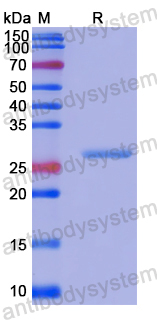
27.48 kDa
Nature
Recombinant
Applications
ELISA, Immunogen, SDS-PAGE, WB, Bioactivity testing in progress
Endotoxin level
Please contact with the lab for this information.
Purity
>90% as determined by SDS-PAGE.
Accession
Q13438
Form
Lyophilized
Storage buffer
Lyophilized from a solution in PBS pH 7.4, 0.02% NLS, 1mM EDTA, 4% Trehalose, 1% Mannitol.
Reconstitution
Reconstitute in sterile water for a stock solution. A copy of datasheet will be provided with the products, please refer to it for details.
Shipping
In general, proteins are provided as lyophilized powder/frozen liquid. They are shipped out with dry ice/blue ice unless customers require otherwise.
Stability and Storage
Use a manual defrost freezer and avoid repeated freeze thaw cycles. Store at 2 to 8°C for frequent use. Store at -20 to -80°C for twelve months from the date of receipt.
Alternative Names
Protein OS-9, OS9, Amplified in osteosarcoma 9
Note
For research use only.
Interaction of structural core protein of classical swine fever virus with endoplasmic reticulum-associated degradation pathway protein OS9., PMID:25010283
Characterization of the Grp94/OS-9 chaperone-lectin complex., PMID:25193139
A context-independent N-glycan signal targets the misfolded extracellular domain of Arabidopsis STRUBBELIG to endoplasmic-reticulum-associated degradation., PMID:25251695
[Proteomics research of bufalin-induced apoptosis in osteosarcoma cell lines]., PMID:25272506
A novel long non-coding RNA ENST00000480739 suppresses tumour cell invasion by regulating OS-9 and HIF-1α in pancreatic ductal adenocarcinoma., PMID:25314054
Glucosidase II and MRH-domain containing proteins in the secretory pathway., PMID:25692846
Bioinformatics approach for choosing the correct reference genes when studying gene expression in human keratinocytes., PMID:25980460
A Novel Role of OS-9 in the Maintenance of Intestinal Barrier Function from Hypoxia-induced Injury via p38-dependent Pathway., PMID:25999789
Promotion of Endoplasmic Reticulum-Associated Degradation of Procathepsin D by Human Herpesvirus 8-Encoded Viral Interleukin-6., PMID:26018151
Crystal Structure and Functional Analyses of the Lectin Domain of Glucosidase II: Insights into Oligomannose Recognition., PMID:26062005
IRE1α is an endogenous substrate of endoplasmic-reticulum-associated degradation., PMID:26551274
OS9 Protein Interacts with Na-K-2Cl Co-transporter (NKCC2) and Targets Its Immature Form for the Endoplasmic Reticulum-associated Degradation Pathway., PMID:26721884
[Research Progress in the Core Proteins of the Classical Swine Fever Virus]., PMID:26738299
Grp94 Protein Delivers γ-Aminobutyric Acid Type A (GABAA) Receptors to Hrd1 Protein-mediated Endoplasmic Reticulum-associated Degradation., PMID:26945068
Mannosidase IA is in Quality Control Vesicles and Participates in Glycoprotein Targeting to ERAD., PMID:27108681
Hypoxia Associated Proteolytic Processing of OS-9 by the Metalloproteinase Meprin β., PMID:27478637
Posttranscriptional Regulation of Glycoprotein Quality Control in the Endoplasmic Reticulum Is Controlled by the E2 Ub-Conjugating Enzyme UBC6e., PMID:27570074
Gene panel sequencing improves the diagnostic work-up of patients with idiopathic erythrocytosis and identifies new mutations., PMID:27651169
Quality control of glycoprotein folding and ERAD: the role of N-glycan handling, EDEM1 and OS-9., PMID:27803995
ERAD Tuning of the HRD1 Complex Component AtOS9 Is Modulated by an ER-Bound E2, UBC32., PMID:28040559
The endoplasmic reticulum-associated protein, OS-9, behaves as a lectin in targeting the immature calcium-sensing receptor., PMID:28419469
A phase 2 study of the first imipridone ONC201, a selective DRD2 antagonist for oncology, administered every three weeks in recurrent glioblastoma., PMID:29108308
Effect of a rare genetic variant of TM7SF4 gene on osteoclasts of patients with Paget's disease of bone., PMID:29145829
DNA methylation signatures at endoplasmic reticulum stress genes are associated with adiposity and insulin resistance., PMID:29221916
Abnormal expression of ER quality control and ER associated degradation proteins in the dorsolateral prefrontal cortex in schizophrenia., PMID:29496332
Redundant and Antagonistic Roles of XTP3B and OS9 in Decoding Glycan and Non-glycan Degrons in ER-Associated Degradation., PMID:29706535
Amyotrophic lateral sclerosis (ALS) and Alzheimer's disease (AD) are characterised by differential activation of ER stress pathways: focus on UPR target genes., PMID:29725981
Application of NanoBiT for Monitoring Dimerization of the Null Hong Kong Variant of α-1-Antitrypsin, NHK, in Living Cells., PMID:29876740
Human Cytomegalovirus Tropism Modulator UL148 Interacts with SEL1L, a Cellular Factor That Governs Endoplasmic Reticulum-Associated Degradation of the Viral Envelope Glycoprotein gO., PMID:29997207
Proteomic characterization of endogenous substrates of mammalian ubiquitin ligase Hrd1., PMID:30167107
Understanding molecular mechanisms of Rhodiola rosea for the treatment of acute mountain sickness through computational approaches (a STROBE-compliant article)., PMID:30278484
Effects of 2-(2-Chlorophenyl)ethylbiguanide on ERAD Component Expression in HT-29 Cells Under a Serum- and Glucose-Deprived Condition., PMID:30783947
Sequence optimization and glycosylation of vasoinhibin: Pitfalls of recombinant production., PMID:31051246
Monochorionic twins with selective fetal growth restriction: insight from placental whole-transcriptome analysis., PMID:32437666
Transcriptionomic Study on Apoptosis of SKOV-3 Cells Induced by Phycoerythrin from Gracilaria lemaneiformis., PMID:32900352
Coronavirus interactions with the cellular autophagy machinery., PMID:32964796
ABBV-085, Antibody-Drug Conjugate Targeting LRRC15, Is Effective in Osteosarcoma: A Report by the Pediatric Preclinical Testing Consortium., PMID:33298592
SEL1L degradation intermediates stimulate cytosolic aggregation of polyglutamine-expanded protein., PMID:33576152
Tauroursodeoxycholic acid attenuates cisplatin-induced ototoxicity by inhibiting the accumulation and aggregation of unfolded or misfolded proteins in the endoplasmic reticulum., PMID:33631298
New insights into the role of endoplasmic reticulum-associated degradation in Bartter Syndrome Type 1., PMID:33973684
Asaronic acid inhibits ER stress sensors and boosts functionality of ubiquitin-proteasomal degradation in 7β-hydroxycholesterol-loaded macrophages., PMID:34601222
Proteomics-based identification of the role of osteosarcoma amplified-9 in hepatocellular carcinoma recurrence., PMID:35429130
Circadian Oscillation Pattern of Endoplasmic Reticulum Quality Control (ERQC) Components in Human Embryonic Kidney HEK293 Cells., PMID:37033333
SEL1L-HRD1 interaction is prerequisite for the formation of a functional HRD1 ERAD complex., PMID:37333389
Changes in the liver of Tinca tinca under successive domestication using an integrated multi-omics approach., PMID:37354750
AUP1 Regulates the Endoplasmic Reticulum-Associated Degradation and Polyubiquitination of NKCC2., PMID:38474353
Turnover of EDEM1, an ERAD-enhancing factor, is mediated by multiple degradation routes., PMID:38682256
ER-to-lysosome-associated degradation acts as failsafe mechanism upon ERAD dysfunction., PMID:38773321
Japanese encephalitis virus hijacks ER-associated degradation regulators for its replication., PMID:38787366
Target deconvolution of an insulin hypersecretion-inducer acting through VDAC1 with a distinct transcriptomic signature in beta-cells., PMID:39763878

 For research use only. Not for human or drug use.


