Catalog No.
YHA48101
Expression system
E. coli
Species
Homo sapiens (Human)
Protein length
Gly186-Gln536
Predicted molecular weight
40.77 kDa
Nature
Recombinant
Applications
ELISA, Immunogen, SDS-PAGE, WB, Bioactivity testing in progress
Endotoxin level
Please contact with the lab for this information.
Purity
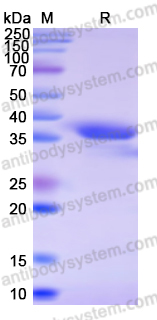
>90% as determined by SDS-PAGE.
Accession
O15270
Form
Lyophilized
Storage buffer
Lyophilized from a solution in PBS pH 7.4, 0.02% NLS, 1mM EDTA, 4% Trehalose, 1% Mannitol.
Reconstitution
Reconstitute in sterile water for a stock solution. A copy of datasheet will be provided with the products, please refer to it for details.
Shipping
In general, proteins are provided as lyophilized powder/frozen liquid. They are shipped out with dry ice/blue ice unless customers require otherwise.
Stability and Storage
Use a manual defrost freezer and avoid repeated freeze thaw cycles. Store at 2 to 8°C for frequent use. Store at -20 to -80°C for twelve months from the date of receipt.
Alternative Names
LCB2a, SPT 2, Serine palmitoyltransferase 2, LCB 2, KIAA0526, Long chain base biosynthesis protein 2, SPTLC2, LCB2, Long chain base biosynthesis protein 2a, Serine-palmitoyl-CoA transferase 2
Note
For research use only.
In Human and Mouse Spino-Cerebellar Tissue, Ataxin-2 Expansion Affects Ceramide-Sphingomyelin Metabolism., PMID:31766565
Endothelial Sphingolipid De Novo Synthesis Controls Blood Pressure by Regulating Signal Transduction and NO via Ceramide., PMID:32172624
Demyelination in hereditary sensory neuropathy type-1C., PMID:32730653
Polyphenol-induced improvements in glucose metabolism are associated with bile acid signaling to intestinal farnesoid X receptor., PMID:32771984
Increased expression of serine palmitoyl transferase and ORMDL3 polymorphism are associated with eosinophilic inflammation and airflow limitation in aspirin-exacerbated respiratory disease., PMID:33031402
Ceramides are necessary and sufficient for diet-induced impairment of thermogenic adipocytes., PMID:33352310
Cardiomyocyte Krüppel-Like Factor 5 Promotes De Novo Ceramide Biosynthesis and Contributes to Eccentric Remodeling in Ischemic Cardiomyopathy., PMID:33430631
Structural insights into the regulation of human serine palmitoyltransferase complexes., PMID:33558761
Structural insights into the assembly and substrate selectivity of human SPT-ORMDL3 complex., PMID:33558762
Rare mutations in ATL3, SPTLC2 and SCN9A explaining hereditary sensory neuropathy and congenital insensitivity to pain in a Brazilian cohort., PMID:34090020
The aryl hydrocarbon receptor activates ceramide biosynthesis in mice contributing to hepatic lipogenesis., PMID:34097992
The role of the 'sphingoid motif' in shaping the molecular interactions of sphingolipids in biomembranes., PMID:34302797
An iPSC model of hereditary sensory neuropathy-1 reveals L-serine-responsive deficits in neuronal ganglioside composition and axoglial interactions., PMID:34337561
[Clinicopathological features and molecular genetic changes of lung salivary gland-type clear cell carcinoma]., PMID:34405605
Effect of Gegen Qinlian Decoction on Hepatic Gluconeogenesis in ZDF Rats with Type 2 Diabetes Mellitus Based on the Farnesol X Receptor/Ceramide Signaling Pathway Regulating Mitochondrial Metabolism and Endoplasmic Reticulum Stress., PMID:34422083
1-deoxysphingolipids bind to COUP-TF to modulate lymphatic and cardiac cell development., PMID:34762852
Precision mouse models of Yars/dominant intermediate Charcot-Marie-Tooth disease type C and Sptlc1/hereditary sensory and autonomic neuropathy type 1., PMID:34875719
Involvement of Huanglian Jiedu Decoction on Microglia with Abnormal Sphingolipid Metabolism in Alzheimer's Disease., PMID:35391788
Upregulation of the serine palmitoyltransferase subunit SPTLC2 by endoplasmic reticulum stress inhibits the hepatic insulin response., PMID:35513574
Description of a patient cohort with Hereditary Sensory Neuropathy type 1 without retinal disease Macular Telangiectasia type 2 - implications for retinal screening in HSN1., PMID:35837722
Triptolide Inhibits the Biological Processes of HUVECs and HepG2 Cells via the Serine Palmitoyltransferase Long Chain Base Subunit 2/Sphingosine-1-Phosphate Signaling Pathway., PMID:36438896
SPTLC2 ameliorates chondrocyte dysfunction and extracellular matrix metabolism disturbance in vitro and in vivo in osteoarthritis., PMID:36828166
Mutation screening of SPTLC1 and SPTLC2 in amyotrophic lateral sclerosis., PMID:36966328
Structural insights into the substrate recognition of serine palmitoyltransferase from Sphingobacterium multivorum., PMID:37030501
Specific Deoxyceramide Species Correlate with Expression of Macular Telangiectasia Type 2 (MacTel2) in a SPTLC2 Carrier HSAN1 Family., PMID:37107689
Hepatic deletion of serine palmitoyl transferase 2 impairs ceramide/sphingomyelin balance, bile acids homeostasis and leads to liver damage in mice., PMID:37224999
Expression of Ceramide-Metabolizing Enzymes in the Heart Adipose Tissue of Cardiovascular Disease Patients., PMID:37298446
The regulatory effect of Angelicae Sinensis Radix on neuroendocrine-immune network and sphingolipid metabolism in CUMS-induced model of depression., PMID:37769886
Systematic identification of gene combinations to target in innate immune cells to enhance T cell activation., PMID:37813864
Recurrent de novo SPTLC2 variant causes childhood-onset amyotrophic lateral sclerosis (ALS) by excess sphingolipid synthesis., PMID:38041679
Recurrent de-novo gain-of-function mutation in SPTLC2 confirms dysregulated sphingolipid production to cause juvenile amyotrophic lateral sclerosis., PMID:38041684
Ceramide enhanced the hepatic glucagon response through regulation of CREB activity., PMID:38142481
The relevance between abnormally elevated serum ceramide and cognitive impairment in Alzheimer's disease model mice and its mechanism., PMID:38277004
Risk model based on genes regulating the response of tumor cells to T-cell-mediated killing in esophageal squamous cell carcinoma., PMID:38305770
SPTLC2 variants are associated with early-onset ALS and FTD due to aberrant sphingolipid synthesis., PMID:38316966
Serine enrichment in tumors promotes regulatory T cell accumulation through sphinganine-mediated regulation of c-Fos., PMID:38640251
SPTLC3 Is Essential for Complex I Activity and Contributes to Ischemic Cardiomyopathy., PMID:38660786
Functional and Molecular Characterization of New SPTLC1 Missense Variants in Patients with Hereditary Sensory and Autonomic Neuropathy Type 1 (HSAN1)., PMID:38927628
Modulation of Ceramide-Induced Apoptosis in Enteric Neurons by Aryl Hydrocarbon Receptor Signaling: Unveiling a New Pathway beyond ER Stress., PMID:39201268
Impact of reduced hepatic ceramide levels in high-fat diet mice on glucose metabolism., PMID:39427846
Altered sphingolipid biosynthetic flux and lipoprotein trafficking contribute to trans-fat-induced atherosclerosis., PMID:39547233
SPTLC2 drives an EGFR-FAK-HBEGF signaling axis to promote ovarian cancer progression., PMID:39645550
Effect of the SGLT2 inhibitor ipragliflozin on the expression of genes that regulate skin function., PMID:39710589
SFAs facilitates ceramide's de novo synthesis via TLR4 and intensifies hepatocyte lipotoxicity., PMID:39793229
Ceramides increase mitochondrial permeabilization to trigger mtDNA-dependent inflammation in astrocytes during brain ischemia., PMID:39956315
Reversed role of CD36 deficiency in high-fat diet or methionine/choline-deficient diet-induced hepatic steatosis and steatohepatitis., PMID:40110132
Identification of Mitochondrial and Succinylation Modification-Related Gene Signature in Ischemic Stroke., PMID:40261608
Exploring lipid metabolism-associated gene biomarkers and their regulatory mechanisms in nasopharyngeal carcinoma., PMID:40294966
Renshenjian decoction alleviates diabetes via HIF-1α/SPTLC2 pathway by targeting ceramide synthesis., PMID:40316155
Differential Effects of Sphingolipids on Cell Death and Antioxidant Defenses in Type 1 and Type 2 Endometrial Cancer Cells., PMID:40429618

 For research use only. Not for human or drug use.


