Catalog No.
YHH43801
Expression system
E. coli
Species
Homo sapiens (Human)
Protein length
Glu761-Lys876
Predicted molecular weight
17.05 kDa
Nature
Recombinant
Applications
ELISA, Immunogen, SDS-PAGE, WB, Bioactivity testing in progress
Endotoxin level
Please contact with the lab for this information.
Purity
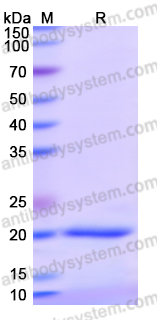
>90% as determined by SDS-PAGE.
Accession
Q1MSJ5
Form
Lyophilized
Storage buffer
Lyophilized from a solution in PBS pH 7.4, 0.02% NLS, 1mM EDTA, 4% Trehalose, 1% Mannitol.
Reconstitution
Reconstitute in sterile water for a stock solution. A copy of datasheet will be provided with the products, please refer to it for details.
Shipping
In general, proteins are provided as lyophilized powder/frozen liquid. They are shipped out with dry ice/blue ice unless customers require otherwise.
Stability and Storage
Use a manual defrost freezer and avoid repeated freeze thaw cycles. Store at 2 to 8°C for frequent use. Store at -20 to -80°C for twelve months from the date of receipt.
Alternative Names
CSPP1, CSPP, Centrosome and spindle pole-associated protein 1
Note
For research use only.
CSPP and CSPP-L associate with centrosomes and microtubules and differently affect microtubule organization., PMID:16826565
Characterization of the FAM110 gene family., PMID:17499476
Centrosome/spindle pole-associated protein regulates cytokinesis via promoting the recruitment of MyoGEF to the central spindle., PMID:19129481
CSPP is a ciliary protein interacting with Nephrocystin 8 and required for cilia formation., PMID:20519441
Etomidate induces cytotoxic effects and gene expression in a murine leukemia macrophage cell line (RAW264.7)., PMID:21737642
Mutations in CSPP1, encoding a core centrosomal protein, cause a range of ciliopathy phenotypes in humans., PMID:24360803
Mutations in CSPP1 lead to classical Joubert syndrome., PMID:24360807
Mutations in CSPP1 cause primary cilia abnormalities and Joubert syndrome with or without Jeune asphyxiating thoracic dystrophy., PMID:24360808
Nuclear CSPP1 expression defined subtypes of basal-like breast cancer., PMID:24901235
8q13.1-q13.2 deletion associated with inferior cerebellar vermian hypoplasia and digital anomalies: a new syndrome?, PMID:25693585
Intrafamilial clinical heterogeneity of CSPP1-related ciliopathy., PMID:25997910
CSPP-L Associates with the Desmosome of Polarized Epithelial Cells and Is Required for Normal Spheroid Formation., PMID:26241740
Mitotic Protein CSPP1 Interacts with CENP-H Protein to Coordinate Accurate Chromosome Oscillation in Mitosis., PMID:26378239
Fixation methods can differentially affect ciliary protein immunolabeling., PMID:28352462
Genomic profile of oral squamous cell carcinomas with an adjacent leukoplakia or with an erythroleukoplakia that evolved after the treatment of primary tumor: A report of two cases., PMID:28901451
The E3 ubiquitin ligase UBR5 regulates centriolar satellite stability and primary cilia., PMID:29742019
circ-CSPP1 promotes proliferation, invasion and migration of ovarian cancer cells by acting as a miR-1236-3p sponge., PMID:30965236
A CEP104-CSPP1 Complex Is Required for Formation of Primary Cilia Competent in Hedgehog Signaling., PMID:31412255
Proteomic alterations underlie an association with teratozoospermia in obese mice sperm., PMID:31651332
Hsa_circ_CSPP1/MiR-361-5p/ITGB1 Regulates Proliferation and Migration of Cervical Cancer (CC) by Modulating the PI3K-Akt Signaling Pathway., PMID:32046405
Dysfunction of the ciliary ARMC9/TOGARAM1 protein module causes Joubert syndrome., PMID:32453716
Roles of circ-CSPP1 on the proliferation and metastasis of glioma cancer., PMID:32495924
Circular RNA circ-CSPP1 regulates CCNE2 to facilitate hepatocellular carcinoma cell growth via sponging miR-577., PMID:32514247
Pituitary stalk interruption syndrome is characterized by genetic heterogeneity., PMID:33270637
The RNA-Binding Protein HuD Regulates Alternative Splicing and Alternative Polyadenylation in the Mouse Neocortex., PMID:34064652
Identification of circRNA circ-CSPP1 as a potent driver of colorectal cancer by directly targeting the miR-431/LASP1 axis., PMID:34124372
Circ-CSPP1 knockdown suppresses hepatocellular carcinoma progression through miR-493-5p releasing-mediated HMGB1 downregulation., PMID:34182091
Circ_CSPP1 Regulates the Development of Non-small Cell Lung Cancer via the miR-486-3p/BRD9 Axis., PMID:35678942
Circle RNA circCSPP1 promotes human osteosarcoma cell proliferation and increases glucose metabolism by suppressing miR-200c maturation., PMID:35713481
Identifies microtubule-binding protein CSPP1 as a novel cancer biomarker associated with ferroptosis and tumor microenvironment., PMID:35832625
Clinical and genetic spectrum from a prototype of ciliopathy: Joubert syndrome., PMID:36580738
CCDC66 regulates primary cilium length and signaling via interactions with transition zone and axonemal proteins., PMID:36606424
CSPP1 stabilizes growing microtubule ends and damaged lattices from the luminal side., PMID:36752787
Circular RNA CSPP1 motivates renal cell carcinoma carcinogenesis and the Warburg effect by targeting RAC1 through microRNA-493-5p., PMID:37722005
Genome-Wide Characterization of Fennel (Anethum foeniculum) MiRNome and Identification of its Potential Targets in Homo sapiens and Arabidopsis thaliana: An Inter and Intra-species Computational Scrutiny., PMID:38017284
Corrigendum to "Identifies microtubule-binding protein CSPP1 as a novel cancer biomarker associated with ferroptosis and tumor microenvironment" [Comput Struct Biotechnol J 20 (2022) 3322-3335]., PMID:38022700
Early prenatal diagnosis of causative homozygous variants in ASCC1 in a fetus with cystic hygroma and additional homozygous variants of unknown significance associated with a neurological phenotype not visible in early gestation: Dual diagnosis or not?, PMID:38342957
CSPP1 stabilizes microtubules by capping both plus and minus ends., PMID:38389254
Tripolyphosphate-chitosan-pea protein interactions confers long-term stability to 3D printed high internal phase Pickering emulsions., PMID:39608119
A network of interacting ciliary tip proteins with opposing activities imparts slow and processive microtubule growth., PMID:39856351

 For research use only. Not for human or drug use.


