Catalog No.
YHF02401
Expression system
E. coli
Species
Homo sapiens (Human)
Protein length
Met1-Arg182
Predicted molecular weight
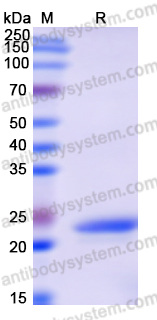
23.20 kDa
Nature
Recombinant
Applications
ELISA, Immunogen, SDS-PAGE, WB, Bioactivity testing in progress
Endotoxin level
Please contact with the lab for this information.
Purity
>90% as determined by SDS-PAGE.
Accession
P54252
Form
Lyophilized
Storage buffer
Lyophilized from a solution in PBS pH 7.4, 0.02% NLS, 1mM EDTA, 4% Trehalose, 1% Mannitol.
Reconstitution
Reconstitute in sterile water for a stock solution. A copy of datasheet will be provided with the products, please refer to it for details.
Shipping
In general, proteins are provided as lyophilized powder/frozen liquid. They are shipped out with dry ice/blue ice unless customers require otherwise.
Stability and Storage
Use a manual defrost freezer and avoid repeated freeze thaw cycles. Store at 2 to 8°C for frequent use. Store at -20 to -80°C for twelve months from the date of receipt.
Alternative Names
ATX3, MJD1, MJD, SCA3, Ataxin-3, Spinocerebellar ataxia type 3 protein, ATXN3, Machado-Joseph disease protein 1
Note
For research use only.
VCP/p97 UFMylation stabilizes BECN1 and facilitates the initiation of autophagy., PMID:38762759
ATXN3 functions as a tumor suppressor through potentiating galectin-9-mediated apoptosis in human colon adenocarcinoma., PMID:38815863
VCP regulates early tau seed amplification via specific cofactors., PMID:38826306
Global DNA methylation is not elevated in blood samples from Machado-Joseph disease mutation carriers., PMID:38900099
Endosome mediated nucleocytoplasmic trafficking and endomembrane allocation is crucial to polyglutamine toxicity., PMID:38900277
Identification of novel drug targets for multiple sclerosis by integrating plasma genetics and proteomes., PMID:38964432
Trehalose prevents the formation of aggregates of mutant ataxin-3 and reduces soluble ataxin-3 protein levels in an SCA3 cell model., PMID:38964453
Caffeine Consumption and Interaction with ADORA2A, CYP1A2 and NOS1 Variants Do Not Influence Age at Onset of Machado-Joseph Disease., PMID:38969840
VCP/p97-associated proteins are binders and debranching enzymes of K48-K63-branched ubiquitin chains., PMID:38977901
Production of Spinocerebellar Ataxia Type 3 Model Mice by Intravenous Injection of AAV-PHP.B Vectors., PMID:39000316
The parkin V380L variant is a genetic modifier of Machado-Joseph disease with impact on mitophagy., PMID:39088078
Preimplantation Genetic Testing of Spinocerebellar Ataxia Type 3/Machado-Joseph Disease-Robust Tools for Direct and Indirect Detection of the ATXN3 (CAG)n Repeat Expansion., PMID:39125643
Specific Biomarkers in Spinocerebellar Ataxia Type 3: A Systematic Review of Their Potential Uses in Disease Staging and Treatment Assessment., PMID:39125644
Investigation of Spinocerebellar Ataxia (SCA) Disease in Iranian Patients and Accurate Trinucleotide Repeat Detection in the SCA3 by TP-PCR Method., PMID:39155322
TAK-861, a potent, orally available orexin receptor 2-selective agonist, produces wakefulness in monkeys and improves narcolepsy-like phenotypes in mouse models., PMID:39242684
PIAS1 S510G variant acts as a genetic modifier of spinocerebellar ataxia type 3 by selectively impairing mutant ataxin-3 proteostasis., PMID:39293559
Fructose-2,6-bisphosphate restores DNA repair activity of PNKP and ameliorates neurodegenerative symptoms in Huntington's disease., PMID:39298485
Treatment of neurological pathology and inflammation in Machado-Joseph disease through in vivo self-assembled siRNA., PMID:39315766
ATXN3: a multifunctional protein involved in the polyglutamine disease spinocerebellar ataxia type 3., PMID:39320846
Age-dependent somatic expansion of the ATXN3 CAG repeat in the blood and buccal swab DNA of individuals with spinocerebellar ataxia type 3/Machado-Joseph disease., PMID:39375222
Small Molecules Inducing Autophagic Degradation of Expanded Polyglutamine Protein through Interaction with Both Mutant ATXN3 and LC3., PMID:39409036
Identification and Copy Number Variant Analysis of Enhancer Regions of Genes Causing Spinocerebellar Ataxia., PMID:39456985
Astragaloside IV reduces mutant Ataxin-3 levels and supports mitochondrial function in Spinocerebellar Ataxia Type 3., PMID:39472629
Mutation Screening of ATXN1, ATXN2, and ATXN3 in Amyotrophic Lateral Sclerosis., PMID:39496878
Evolutionary model of repeat insertions in Ataxin-3 traces the origin of the polyglutamine stretch to an ancestral ubiquitin binding module., PMID:39589068
Generation of induced pluripotent stem cell line (ZZUi037-A) from a patient with spinocerebellar ataxia type 3., PMID:39603094
Regional distribution of polymorphisms associated to the disease-causing gene of spinocerebellar ataxia type 3., PMID:39666145
The deubiquitinating enzyme ATXN3 promotes hepatocellular carcinoma progression by stabilizing TAZ., PMID:39672915
Genetic Analysis of GCA Repeats in the GLS Gene: Implications for Undiagnosed Ataxia and Spinocerebellar Ataxia 3 in Mainland China., PMID:39699045
Biochemical analysis to study wild-type and polyglutamine-expanded ATXN3 species., PMID:39715253
Erinacine A-Enriched Hericium erinaceus Mycelium Ethanol Extract Lessens Cellular Damage in Cell and Drosophila Models of Spinocerebellar Ataxia Type 3 by Improvement of Nrf2 Activation., PMID:39765823
VCP regulates early tau seed amplification via specific cofactors., PMID:39773263
ATXN10 Gene Expansions in Mexican Patients with Ataxia Without Epilepsy., PMID:39820777
Associations between CAG repeat size, brain and spinal cord volume loss, and motor symptoms in spinocerebellar ataxia type 3: a cohort study., PMID:39849568
Allosteric Modulation of Pathological Ataxin-3 Aggregation: A Path to Spinocerebellar Ataxia Type-3 Therapies., PMID:39896516
Cerebellar lipid dysregulation in SCA3: A comparative study in patients and mice., PMID:39900303
Predicting Which Mitophagy Proteins Are Dysregulated in Spinocerebellar Ataxia Type 3 (SCA3) Using the Auto-p2docking Pipeline., PMID:39941093
Progression of biological markers in spinocerebellar ataxia type 3: analysis of longitudinal data from the ESMI cohort., PMID:39974031
Generation of an induced pluripotent stem cell (iPSC) line (INNDSUi008-A) from a patient with Spinocerebellar Ataxia Type 3., PMID:39987589
ATXN3 deubiquitinates ZEB1 and facilitates epithelial-mesenchymal transition in glioblastoma., PMID:40050358
Whole Genome Sequencing-Based Diagnosis of Spinocerebellar Ataxia Type 3 Repeat Expansion Neuromuscular Disorders in an Undiagnosed Patient: Breaking Past Diagnostic Boundaries., PMID:40152810
CAG-targeted brain-permeable therapy tested in biallelic humanized polyQ mouse models., PMID:40171277
Beyond the cerebellum: perivascular space burden in spinocerebellar ataxia type 3 extends to multiple brain regions., PMID:40190350
Genome editing in spinocerebellar ataxia type 3 cells improves Golgi apparatus structure., PMID:40204795
Differential effects of lifespan-extending genetic manipulations in an animal model of MJD/SCA3., PMID:40287101
Autophagy- and oxidative stress-related protein deregulation mediated by extracellular vesicles of human MJD/SCA3 iPSC-derived neuroepithelial stem cells and differentiated neural cultures., PMID:40374597
Accurate Quantification of Mutant and Wild-Type polyQ Proteins Using Simple Western Capillary Immunoassays., PMID:40450087
Progressive subcortical involvement as spinocerebellar ataxia type 3 advances., PMID:40468428
Roles of orexinergic and noradrenergic neuronal activity in ketamine-induced sedation: a study using an orexin-ataxin-3 transgenic rat model., PMID:40490582

 For research use only. Not for human or drug use.


