
Porphyromonas gingivalis PorM Nanobody: A Targeted Tool for T9SS and Bacterial Pathogenesis Research
Explore the role of PorM in the Type IX Secretion System (T9SS) of Porphyromonas gingivalis and the potential applications of PorM-specific Nanobodies in bacterial protein characterization, secretion-system research, and host–pathogen studies.
Porphyromonas gingivalis and the Type IX Secretion System
Porphyromonas gingivalis is a Gram-negative anaerobic bacterium strongly associated with periodontal disease and is an important model organism for investigating bacterial virulence and host–microbe interactions.
A distinctive feature of P. gingivalis is its Type IX Secretion System (T9SS), a specialized protein secretion pathway that transports a range of proteins associated with bacterial colonization, nutrient acquisition, and virulence.
Why Target PorM?
The T9SS is a complex multi-component secretion system that enables P. gingivalis to transport specific proteins from the bacterial cell to the cell surface or extracellular environment. Proper coordination between membrane-associated and outer-membrane components is essential for efficient protein secretion.
Investigating PorM can therefore support research into the organization and functional properties of the T9SS and its relationship with bacterial virulence.
T9SS Structure & Function
Investigate the molecular organization and functional characteristics of the Type IX Secretion System.
Protein Secretion
Study mechanisms involved in bacterial protein transport and secretion.
Virulence Research
Explore molecular pathways associated with P. gingivalis virulence and bacterial survival.
Host–Pathogen Interactions
Support studies investigating interactions between periodontal pathogens and host biological systems.
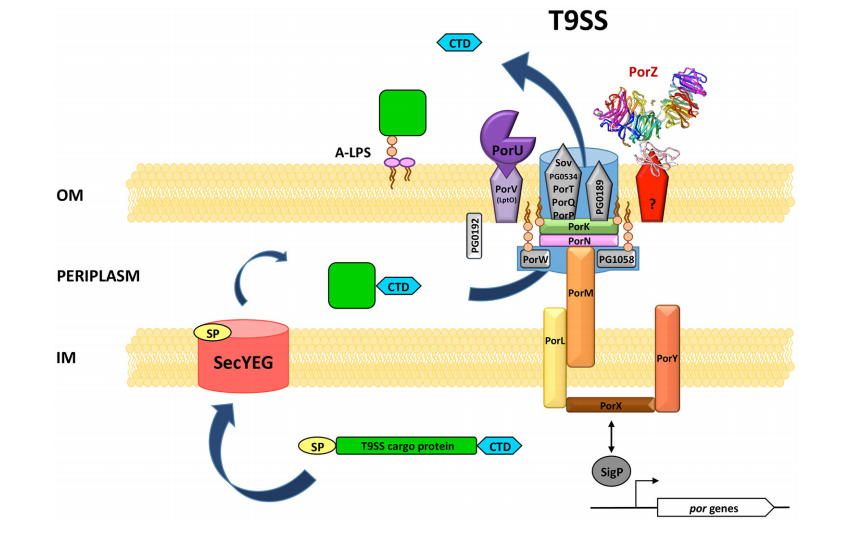
Hypothetical model of the structure and function of P.gingivalis T9SS. (Front Cell Infect Microbiol. 2017 May 26:7:215. )
Why Use a PorM Nanobody?
Nanobodies are compact, single-domain antigen-binding molecules derived from the variable domains of camelid heavy-chain antibodies. Their small molecular size, structural stability, and ability to recognize defined antigenic sites make them valuable research reagents for protein characterization.
Compared with conventional antibodies, the compact architecture of Nanobodies can offer potential advantages in applications involving sterically restricted binding sites, membrane-associated proteins, and multi-protein complexes.
Research Applications
01. Protein Detection
Support the detection and characterization of PorM in recombinant or bacterial-derived samples, subject to application-specific validation.
02. Protein Localization
Provide a molecular probe for investigating the localization and distribution of PorM within P. gingivalis.
03. T9SS Characterization
Complement studies of other T9SS components to investigate the organization and function of the secretion machinery.
04. Protein–Protein Interaction
Support experimental workflows designed to investigate interactions between PorM and other components of the secretion apparatus.
05. Bacterial Pathogenesis
Contribute to studies of molecular mechanisms associated with P. gingivalis survival, colonization, and virulence.
06. Host–Microbe Research
Support broader investigations into periodontal pathogens and host–pathogen interactions.
From PorM Recognition to T9SS Research
Supporting Research on Periodontal Pathogens
The increasing understanding of bacterial secretion systems has highlighted the importance of examining virulence mechanisms at the molecular level. For P. gingivalis, the T9SS represents an important research area because of its connection with the secretion and surface presentation of multiple bacterial proteins.
A PorM-specific Nanobody provides researchers with a target-focused molecular tool that can complement antibodies, recombinant proteins, and other reagents used to characterize the T9SS.
Key Research Areas
PorM Nanobody
Targeted molecular recognition of P. gingivalis PorM.
T9SS Research
Investigation of the Type IX Secretion System and its components.
Protein Characterization
Detection, localization, and molecular analysis of bacterial proteins.
Pathogen Research
Study of bacterial virulence mechanisms and host–pathogen biology.
Research-Grade Molecular Tools from AntibodySystem
AntibodySystem provides research-grade molecular reagents designed to support studies involving bacterial proteins, pathogen-associated targets, protein interactions, and host–microbe biology.
The Porphyromonas gingivalis PorM Nanobody expands the molecular toolkit available to researchers investigating T9SS biology, bacterial protein secretion, and P. gingivalis-associated pathogenic mechanisms.
| Catalog No. | Product Name | Applications |
|---|---|---|
| RXX05902 | Anti-Porphyromonas gingivalis porM Nanobody (SAA0959) | ELISA |
| RXX05903 | Anti-Porphyromonas gingivalis porM Nanobody (SAA0966) | ELISA |
| RXX05904 | Anti-Porphyromonas gingivalis porM Nanobody (SAA1181) | ELISA, SPR |
| RXX05901 | Anti-P.gingivalis PorM Nanobody (Nb01) | ELISA, WB |


