
Why Is AAV Capsid Characterization Becoming Increasingly Important? Genome Titer Alone Tells Only Part of the Story
For many years, viral titer has been one of the key parameters reported in AAV research. Whether determined by qPCR or ddPCR, researchers typically report the Vector Genome Titer (vg/mL) of an AAV preparation and use this value as an important measure of viral production and sample quality.
In recent years, however, an increasing number of AAV studies have begun to include another category of analysis: Capsid Characterization.
In addition to reporting vector genome titer, researchers are increasingly evaluating capsid proteins, viral particle integrity, Empty/Full Capsid ratios, capsid consistency, and other relevant attributes to obtain a more comprehensive view of AAV quality.
Why is this shift occurring?
The answer lies in the different information provided by these analyses. Genome titer tells us how many vector genomes are present, whereas capsid characterization provides additional information about the integrity, consistency, and quality attributes of the viral particles.
For AAV research and development, these measurements are complementary rather than interchangeable.
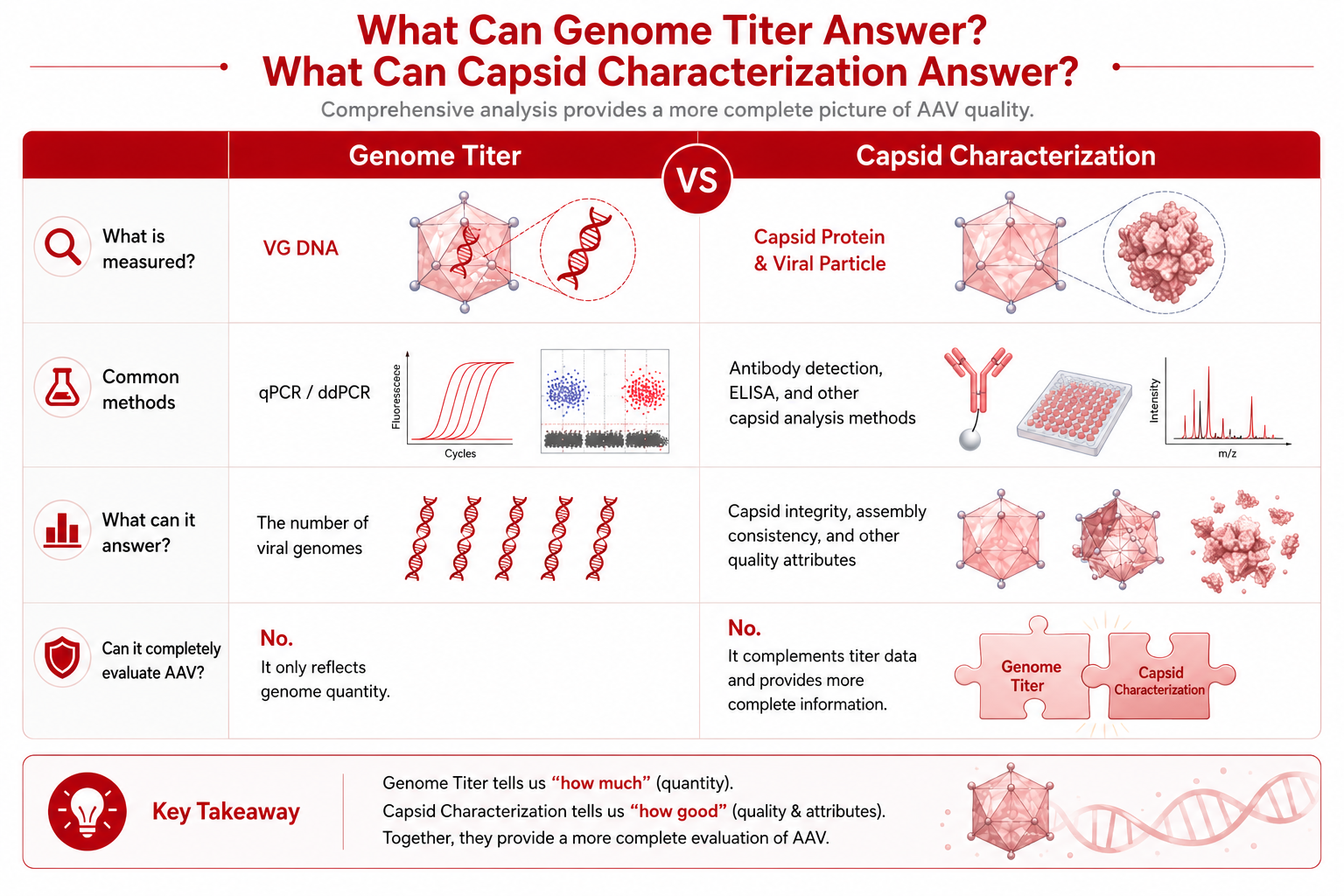

Genome Titer Measures Quantity—but Does Not Fully Reflect AAV Quality
qPCR and ddPCR are among the most commonly used methods for determining AAV genome titer. These assays quantify viral DNA sequences and are therefore commonly used to determine the number of Vector Genomes (VG) in an AAV preparation.
Vector genome titer is an important parameter for evaluating viral packaging efficiency, calculating dosing, and comparing samples across different batches. As a result, it remains a fundamental measurement in AAV research.
However, Genome Titer alone cannot answer several important questions about the viral particles:
· Is the capsid correctly assembled?
· Are the viral particles intact?
· Is there a high proportion of Empty Capsids?
· Are capsid characteristics consistent across different batches?
· Does an engineered Capsid retain its intended structure?
These questions require additional characterization of the capsid and viral particles.
Therefore, Genome Titer and Capsid Characterization should not be viewed as competing measurements. Instead, they provide complementary information that supports a more comprehensive evaluation of AAV preparations.
Why Is the AAV Capsid Becoming Increasingly Important?
The AAV capsid is more than a structural shell that encapsulates DNA.
It plays a critical role in how AAV vectors recognize cellular receptors and enter cells, influences tissue tropism, and contributes to recognition by the host immune system. Consequently, capsid integrity and stability are closely associated with the biological properties of AAV vectors.
As engineered Capsids, novel serotypes, and tissue-targeted delivery technologies continue to advance, increasing attention is being directed toward the capsid itself.
In many AAV studies, the Capsid is not simply a vehicle for delivering genetic material. It is also an important research target for optimizing transduction efficiency, reducing immunogenicity, and improving tissue specificity.
For this reason, systematic capsid characterization has become an increasingly important part of the AAV development workflow.
What Does Capsid Characterization Typically Assess?
The specific attributes of interest vary depending on the research objective. Common areas of AAV capsid characterization include the following.
1. Capsid Protein Expression and Integrity
Assessment of VP1, VP2, and VP3 expression can help determine whether the capsid proteins are expressed appropriately and whether the capsid is properly assembled.
2. Empty/Full Capsid Ratio
Evaluation of the proportion of empty capsids relative to viral particles containing the genome is an increasingly important consideration in CMC development and quality control.
3. Capsid Consistency
Comparing viral preparations across different batches can help determine whether capsid characteristics remain consistent and support improved experimental reproducibility.
4. Engineered Capsid Validation
For novel Capsids generated through Directed Evolution or rational design, characterization is important for determining whether the engineered Capsid retains its intended structure and antigenic properties.
Together, these analyses represent important components of AAV Characterization and enable researchers to develop a more comprehensive understanding of viral quality.
Reliable Research Tools for AAV Capsid Characterization
As interest in AAV capsid characterization continues to grow, reliable research reagents are increasingly important for supporting experimental workflows and method development.
Recombinant Capsid proteins can be used in antibody screening, binding assays, reference standard development, and method development.
AAV-related antibodies are widely used in Western blotting, ELISA, and other capsid detection assays to evaluate capsid expression and characteristics.
AAV ELISA kits can be used for capsid-related quantitative analysis, providing data to support method development and quality assessment.
Together, these research tools support a range of applications in AAV capsid characterization, experimental optimization, and quality control.
AntibodySystem Supports AAV Capsid Research
AntibodySystem offers a range of research-grade products for AAV research, including recombinant proteins, antibodies, and ELISA kits. These products cover multiple AAV-related research applications and can support capsid characterization, antibody development, method development, and basic research.
Recombinant AAV Capsid Proteins
| Catalog No. | Product Name |
|---|---|
| YVV50001 | Recombinant AAV-8 Capsid protein Protein, N-His |
| YVV16801 | Recombinant AAV-2 VP1/Capsid protein VP1 Protein, N-His |
AAV Capsid Antibodies
| Catalog No. | Product Name |
|---|---|
| PVV16801 | Anti-AAV2 Capsid VP1/VP2/VP3 Polyclonal Antibody |
| RVV16803 | Anti-AAV2 Capsids (intact particle) Antibody (A20R) |
| RVV48201 | Anti-AAV8 (Intact particle) Antibody (SAb2452) |
| RVV46705 | Anti-Adeno-Associated Virus 9/AAV9 Antibody (SAb2544) |
| RVV46706 | Anti-Adeno-Associated Virus 9/AAV9 Antibody (SAb2545) |
| RVV46704 | Anti-Adeno-Associated Virus 9/AAV9 Antibody (Fs0365) |
| RVV16807 | Anti-AAV2 (intact particle) Antibody (SAb2541) |
| RVV16801 | Anti-AAV2 VP1/Capsid protein VP1 Antibody (SAA0358) |
| RVV46707 | Monkey Anti-Adeno-Associated Virus 9/AAV9 Antibody (Fs0485) |
| RVV46701 | Anti-AAV9 VP1/Capsid protein VP1 Antibody (SAb2392) |
| RVV46702 | Anti-AAV9 VP1/Capsidprotein VP1 Antibody (SAb2393) |
| RVV46703 | Anti-AAV9 VP1/Capsid protein VP1 Antibody (SAb2394) |
| RVV16802 | Anti-AAV2 VP1/Capsid protein VP1 Antibody (SAA0362) |
| RVV16809 | Anti-AAV2 (intact particle) Antibody (SAb2542) |
| RVV16810 | Anti-AAV1/2/5/6/8/9/DJ/rh.1 VP1/2/3 Antibody (SAb2543) |
| RVV16806 | Anti-AAV8 (intact particle) Antibody (SAb2540) |
| RVV16804 | Anti-AAV1/2/6/8/9/DJ VP1 Antibody (SAb2538) |
| RVV16805 | Anti-AAV8/9/DJ/hr.1 Antibody (SAb2539) |
AAV ELISA Kit
| Catalog No. | Product Name |
|---|---|
| KAV46701 | Anti-AAV9 Antibody ELISA Kit |
Key Takeaways
As AAV technology continues to advance, the focus of research is gradually shifting from "Has the virus been successfully produced?" to "Does the viral preparation truly meet the expected characteristics?"
Genome Titer remains an important parameter for evaluating AAV, but it represents only one aspect of viral characterization. By combining Genome Titer with Capsid Characterization, Empty/Full Capsid analysis, and other quality assessment approaches, researchers can gain a more comprehensive understanding of AAV vector characteristics.
Together, these complementary measurements provide a stronger data foundation for AAV vector development and gene therapy research.


